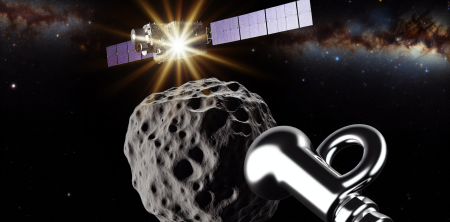
The cosmos holds many secrets, and among them lies the intriguing asteroid known as Psyche. NASA's ambitious Psyche mission aims to unlock these mysteries by exploring this unique celestial body, which is believed to be a remnant of a protoplanet composed primarily of metal. Launched in 2023, the spacecraft is scheduled to arrive at its destination in 2029, poised to provide unprecedented insights into the building blocks of our solar system.
The Journey to Psyche
The Psyche spacecraft was launched aboard a SpaceX Falcon Heavy rocket from NASA's Kennedy Space Center in Florida. This mission marks a significant leap in our understanding of planetary formation. Psyche is not just any asteroid; it is thought to be the exposed metallic core of a protoplanet that never fully formed, offering a unique opportunity to study the interior of a planetary body without needing to drill deep into the ground.
What Makes Psyche Unique?
Psyche is estimated to be about 140 miles (226 kilometers) wide and is located in the asteroid belt between Mars and Jupiter. Unlike most asteroids, which are primarily composed of rock and ice, Psyche is believed to be comprised largely of iron and nickel. This metallic composition suggests that it might represent the remnants of a planet that underwent significant collisions, stripping away its outer layers and leaving the core exposed.
The presence of a massive crater on Psyche’s surface adds to the excitement of this mission. Scientists believe that this crater may provide a glimpse into the asteroid's internal structure, allowing researchers to determine whether it is indeed the core of a protoplanet. Understanding the makeup of Psyche could help answer fundamental questions about how planets form and evolve.
Scientific Objectives of the Psyche Mission
The Psyche mission has several key scientific objectives that aim to deepen our understanding of planetary formation:
- Investigate the Composition: The primary goal is to analyze the asteroid's surface and composition to confirm its metallic nature and assess the abundance of iron and nickel.
- Examine the Crater: The massive crater's structure and composition will be studied to gather insights into the asteroid's history and internal structure.
- Understand Planetary Formation: By studying Psyche, scientists hope to gain clues about the processes that shaped the early solar system and the formation of terrestrial planets.
- Use Advanced Instruments: The spacecraft is equipped with multiple scientific instruments, including a camera, a magnetometer, and a spectrometer, to gather data on Psyche's surface and magnetism.
The Instruments and Technology
The Psyche spacecraft carries a suite of sophisticated instruments designed to study the asteroid in detail:
- Multi-Spectral Imager: This camera will capture high-resolution images of Psyche's surface, revealing its geological features and surface composition.
- Magnetometer: This instrument will measure the magnetic field around Psyche, providing insights into its internal structure and whether it has a remnant magnetic field.
- Near-Infrared Spectrometer: This device will analyze the asteroid's surface materials and help identify the minerals present.
These advanced technologies are crucial for achieving the mission's objectives and will enable scientists to draw conclusions about the asteroid's formation and history.
The Importance of Studying Psyche
Studying Psyche is vital for several reasons:
- Insights into Planet Formation: Psyche's unique composition offers a rare opportunity to study what the cores of terrestrial planets might be like, shedding light on how Earth and its neighboring planets formed.
- Understanding Asteroid Composition: By examining a metallic asteroid, researchers can better understand the variety of materials present in the early solar system.
- Broader Implications for Planetary Science: The findings from the Psyche mission could inform theories about the history of planetary bodies and their evolution over billions of years.
Looking Ahead: The Future of the Psyche Mission
As the Psyche spacecraft makes its journey through the solar system, scientists and space enthusiasts alike are eagerly anticipating the data it will collect. Scheduled to arrive at the asteroid in 2029, the mission's findings could have profound implications for our understanding of planetary formation and the nature of metallic bodies in space.
With each passing year, our knowledge of the universe expands, and missions like Psyche are at the forefront of this exploration. As we prepare for the arrival of the Psyche spacecraft, the anticipation builds for the revelations that await us about this metal-rich world.

