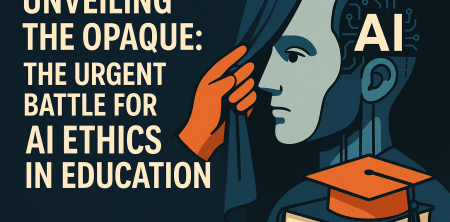
We're living through a truly unprecedented moment in education, aren't we? The year 2026 finds us neck-deep in the integration of Artificial Intelligence into our classrooms and learning environments, a shift that's simultaneously exhilarating and, frankly, a bit terrifying. While AI promises personalized learning paths and automated efficiencies, it's also ignited a fierce debate around AI ethics in education – a conversation that touches on everything from student data privacy to the very nature of truth and critical thought. It's not just a technical issue; it's a deeply human one, impacting how we teach, how students learn, and the kind of society we're building.
As someone who's spent years in the trenches of K-12 and higher education, first as a teacher and then as a dean, I've seen countless technological waves wash over our institutions. But AI? This feels different. It's not just a tool; it's a paradigm shift. And with that shift comes a moral imperative to ensure we're using this power responsibly. We're talking about the future of our students, their academic integrity, and their ability to navigate a world increasingly shaped by algorithms. This isn't a conversation we can afford to defer.
The Privacy Predicament: Whose Data Is It, Anyway?
Let's start with what I believe is one of the most immediate and profound concerns: data privacy. Every interaction a student has with an AI-powered learning tool generates data. Lots of it. Think about it: their learning patterns, their strengths, their weaknesses, even the questions they struggle with. This data is invaluable for personalizing instruction, sure, but it's also a goldmine for the companies developing these AI systems. The question then becomes, who truly owns this data? And how is it being used?
In 2026, the lines are still blurry, and that's a problem. We're seeing situations where learner data, often collected without explicit, transparent consent, is being used to train AI models. While this might sound innocuous on the surface – after all, better data leads to better AI – it raises serious questions about surveillance and commercial exploitation. Are we inadvertently turning our students into unwitting data subjects for corporate profit? And what are the long-term implications of allowing AI systems to build ever-more comprehensive profiles of our children's cognitive and emotional development?
It's not just about what's happening now; it's about setting a precedent. If we don't establish clear, robust regulations and ethical frameworks for data governance in education today, we risk creating a future where student data is routinely commodified, potentially even used for purposes far removed from their educational benefit. We need to demand transparency from AI providers and establish ironclad policies that put student privacy first, making sure that data is used solely for the student's benefit and with their informed consent, or that of their guardians.
Unmasking Algorithmic Bias: The Mirror of Society's Flaws
Another major ethical quagmire in the world of AI ethics in education is algorithmic bias. AI systems learn from the data they're fed, and if that data reflects existing societal inequalities, biases, and prejudices, then the AI will inevitably perpetuate and even amplify them. This isn't some abstract theoretical problem; it has real, tangible consequences for students.
Imagine an AI-powered admissions tool that, unknowingly, favors applicants from certain socioeconomic backgrounds because its training data was skewed. Or a personalized learning system that, due to biased historical data, recommends less challenging material to students from underrepresented groups, inadvertently limiting their academic growth. These aren't far-fetched scenarios; they're very real risks. The datasets used to train many of these AI models often come from historical human decisions, which, unfortunately, have often been anything but impartial. This means AI can bake in existing biases related to race, gender, socioeconomic status, and disability, making it harder for certain students to access opportunities or receive equitable support.
As educators, our core mission is to foster equity and provide every student with an equal opportunity to succeed. If our AI tools are instead reinforcing systemic disadvantages, then we're failing profoundly. We need to critically examine the data sources used to train educational AI, demand rigorous auditing for bias, and actively work to build and utilize AI systems that are designed with fairness and inclusivity at their core. This isn't easy, but it's absolutely essential if we want AI to be a force for good, not a perpetuator of injustice.
The Black Box Problem: Demystifying AI's Decisions
One of the most unsettling aspects of AI's integration into education is what's often referred to as the 'black box problem.' This refers to the lack of transparency in how many AI algorithms arrive at their decisions. An AI might recommend a specific learning path, assign a grade, or even flag a student for intervention, but the underlying reasoning can be opaque, even to the developers themselves. This lack of clarity poses a significant challenge for AI ethics in education.
Think about it: if an AI assigns a student a low grade on an essay, and neither the student nor the teacher can understand *why* that grade was given beyond a general 'it didn't meet criteria,' how can the student learn and improve? How can the teacher effectively intervene? This opacity undermines the very pedagogical process. Learning isn't just about getting a result; it's about understanding the process, identifying areas for growth, and receiving actionable feedback. If AI simply spits out an answer without explaining its reasoning, it deprives students of crucial learning opportunities and teachers of valuable insights.
Furthermore, in contexts like admissions or high-stakes assessments, a lack of transparency can lead to profound distrust and even legal challenges. If a student is denied admission or fails a critical exam based on an AI's decision, they have a right to understand the rationale. We need to push for 'explainable AI' (XAI) in education – systems that can articulate their reasoning in a clear, comprehensible way. This not only builds trust but also empowers educators and students to engage critically with AI's output, rather than blindly accepting it.
The Double-Edged Sword: AI's Promise and Peril
It's easy to get caught up in the ethical dilemmas, but it's important to acknowledge the genuine benefits AI brings to education. Personalized learning, for example, is a game-changer. AI can adapt content and pace to individual student needs in ways a single teacher simply cannot manage for a class of 30. Automated grading for certain types of assignments can free up valuable teacher time, allowing them to focus on more complex pedagogical tasks and one-on-one student interaction. These aren't small benefits; they have the potential to truly transform learning experiences for the better. (See: student data privacy concerns.)
However, alongside these promising applications come significant risks. The concern about plagiarism, for instance, has been amplified by generative AI tools. While the source material suggests that cheating rates haven't necessarily surged, the *nature* of cheating has evolved, making it harder to detect and distinguish genuine student work from AI-generated content. This creates confusion for educators and raises fundamental questions about academic integrity.
Beyond plagiarism, there's the risk of misinformation. AI can generate convincing but entirely false information, and if students rely too heavily on these tools without developing strong critical thinking and source evaluation skills, they become vulnerable to consuming and spreading inaccuracies. Then there's the broader concern about over-reliance: if AI does all the heavy lifting – answering complex questions, summarizing texts, writing essays – what happens to the development of students' own cognitive muscles? Will they lose the ability to think critically, synthesize information, and articulate their own thoughts if an AI is always there to do it for them? For more context, see the staggering investment in accelerated BSN programs.
The Plagiarism Paradox: Confusion, Not Just Cheating
One of the more interesting observations from 2026 is the stability of cheating rates despite widespread AI adoption. My initial thought, and likely yours, was that AI would lead to an explosion of academic dishonesty. But the data suggests something more nuanced: confusion. It seems students and educators alike are grappling with defining what constitutes 'appropriate' AI use. Is using an AI to brainstorm ideas cheating? What about using it to proofread? Or to rephrase a sentence?
This ambiguity is a significant problem for AI ethics in education. When the rules aren't clear, both students and teachers are left in a difficult position. Students might inadvertently cross ethical lines, not out of malice, but because they simply don't understand the boundaries. Teachers, on the other hand, are struggling to enforce policies that haven't caught up with the technology. This isn't just about detecting cheating; it's about fostering an environment of academic integrity and clarity.
We need proactive, clear, and consistent policies regarding AI use in every educational institution, from elementary school through university. These policies shouldn't just be punitive; they should be educational. They need to teach students *how* to use AI responsibly and ethically, distinguishing between tools for learning and tools for circumvention. This also means equipping educators with the training and resources to understand AI, integrate it thoughtfully, and address its challenges head-on.
Policy & Pedagogy: Crafting the Future of Learning
The current landscape demands a robust response in terms of policy and pedagogical practice. We can't simply ban AI, nor can we blindly embrace it. Instead, we need a thoughtful, collaborative approach to integrate AI ethically and effectively into our educational systems. This means developing clear, actionable policies at local, state, and national levels that address the core ethical concerns.
These policies should cover data privacy, ensuring that student data is protected and used only for legitimate educational purposes, with transparent consent. They must mandate bias audits for AI tools used in education and establish mechanisms for redress if bias is detected. Furthermore, policies need to address transparency, pushing for explainable AI where decisions impact student learning or assessment. This isn't just about compliance; it's about building trust in the systems we're asking our students and educators to use.
Beyond policy, there's a huge need for pedagogical shifts. Educators need professional development that goes beyond simply understanding what AI is, to deeply exploring how to leverage it for learning while mitigating its risks. This includes teaching students AI literacy – not just how to use AI, but how to think critically about its outputs, understand its limitations, and develop the human skills that AI cannot replicate, such as creativity, empathy, and complex problem-solving. Our curricula need to evolve to reflect this new reality, preparing students not just for a world with AI, but for a world where they are ethical and discerning users of AI.
Empowering Educators: Professional Development in the Age of AI
Let's be honest, many educators feel overwhelmed by the rapid pace of AI integration. It's a lot to take in, especially when you're already juggling so many responsibilities. But we can't expect our teachers to navigate this complex terrain without proper support and training. This is where professional development becomes absolutely critical for upholding AI ethics in education.
Effective professional development in this area isn't just about showing teachers how to use a new AI tool. It needs to delve into the ethical implications, providing a framework for understanding data privacy, identifying potential biases, and promoting responsible AI use in the classroom. Teachers need to learn how to design assignments that encourage critical thinking and deter AI-generated plagiarism, perhaps by focusing on process, reflection, and unique personal insights that AI struggles to replicate.
Furthermore, educators need to be empowered to discuss AI's ethical dimensions with their students. This means understanding how to facilitate conversations about digital citizenship, data ownership, and the impact of algorithms on information consumption. The goal isn't just to make teachers proficient users of AI, but to make them thoughtful, ethical leaders in a technology-rich learning environment. This is an ongoing process, not a one-off workshop; it requires continuous learning and adaptation as AI evolves.
Building an AI-Literate Generation: Beyond the Hype
The ultimate goal, I believe, is to cultivate an AI-literate generation. This goes far beyond simply knowing how to prompt ChatGPT. It means understanding the underlying principles of AI, its capabilities, its limitations, and its ethical dimensions. It's about equipping students with the discernment to critically evaluate AI-generated content, to understand how their data is used, and to recognize the potential for bias in algorithmic decision-making.
This AI literacy must be woven into the fabric of our curriculum, not treated as an add-on. It should encompass computational thinking, data literacy, and, crucially, ethical reasoning. Students need to be able to ask tough questions: Who built this AI? What data was it trained on? Whose perspectives might be missing? What are the potential consequences of its use? These are the skills that will empower them to be active, informed citizens and responsible professionals in an AI-driven world. (See: AI ethics in education.)
Think about it like media literacy for the digital age. Just as we teach students to critically analyze news sources, we now need to teach them to critically analyze AI outputs. This isn't about fear-mongering; it's about empowerment. It's about ensuring that our students are not passive consumers of AI, but active, ethical shapers of its future trajectory.
The Path Forward: Collaboration and Continuous Vigilance
Navigating the complex landscape of AI ethics in education isn't a task for any single individual or institution. It requires a collaborative effort involving educators, policymakers, AI developers, parents, and students themselves. We need open dialogue, shared research, and a willingness to adapt as the technology evolves. Forums like The Edvocate and The Tech Edvocate are designed precisely for these kinds of conversations, fostering a community where we can collectively tackle these monumental challenges. For more context, see the urgent shift to accelerated BSN programs.
The monetization opportunities in this space, such as AI literacy courses, ethical AI assessment tools, and professional development programs for educators, aren't just about profit. They represent a significant need and an opportunity to build the infrastructure necessary for responsible AI integration. My own ventures, like Entelechy, an AI-powered personal tutor, and Pedagogue, a social network for educators, are built with these considerations in mind – striving to create tools that are beneficial, ethical, and transparent.
Ultimately, our commitment must be to continuous vigilance. AI is not static; it's constantly evolving. Therefore, our ethical frameworks, policies, and pedagogical approaches must also be dynamic, capable of adapting to new challenges and opportunities. We have an incredible chance to harness AI for profound educational good, but only if we approach it with a keen sense of responsibility, an unwavering commitment to equity, and a deep understanding of its ethical implications. The future of learning, and indeed, the future of our society, depends on it.
The Global Picture: AI Ethics Beyond Borders
It's easy to focus on what's happening in our own classrooms and districts, but AI ethics in education is truly a global challenge. Different countries and cultures have varying perspectives on data privacy, surveillance, and the role of technology in learning. What's considered acceptable in one nation might be a serious ethical breach in another. This makes developing universal ethical guidelines incredibly tricky, but also incredibly important.
For example, in some European countries, strict data protection regulations like GDPR have set a high bar for how student data can be collected and used, putting privacy at the forefront. Meanwhile, other regions might prioritize large-scale data collection for national educational improvement, potentially with less emphasis on individual consent. These divergent approaches mean that educational AI tools developed in one part of the world might face significant ethical and legal hurdles when deployed elsewhere.
This global disparity highlights the need for international dialogue and collaboration. We need to learn from each other's successes and failures, sharing best practices and working towards a common understanding of fundamental ethical principles. This doesn't mean imposing a single solution, but rather fostering a shared commitment to human-centric AI that respects diverse cultural values while upholding core ethical tenets like fairness, transparency, and accountability. It's about building a global consensus on what responsible AI in education truly looks like.
AI's Impact on the Teacher's Role: Evolution, Not Replacement
There's a natural anxiety among educators about AI potentially replacing them. I've heard it in countless faculty meetings and hallway conversations. But from my perspective, and what I've seen play out in classrooms, AI isn't about replacement; it's about evolution. The teacher's role is shifting, becoming more nuanced, and in many ways, more impactful.
Think about it: AI can handle repetitive tasks like basic grading, data analysis, and even generating initial lesson plans. This frees up teachers to focus on the truly human aspects of education: mentoring, fostering creativity, emotional support, and facilitating complex discussions that require human empathy and understanding. AI can personalize learning paths, but a human teacher provides the motivation, the real-world connections, and the emotional intelligence needed to guide a student through challenges.
The ethical implication here is that we need to support teachers through this transition. This means not just professional development on *using* AI, but also on *redefining* their professional identity in an AI-augmented classroom. It's about empowering them to become "AI whisperers" – experts at leveraging these tools to enhance learning, while also being the ultimate arbiters of truth, critical thought, and human connection. We need to ensure that AI serves the teacher, allowing them to be more effective, rather than feeling threatened by it.
The Equity Gap: Who Gets Access to Ethical AI?
As we talk about the benefits of AI, we also have to grapple with the reality that these benefits aren't always evenly distributed. There's a significant ethical concern around the equity gap in access to high-quality, ethically developed AI tools. Wealthier districts and institutions often have the resources to invest in cutting-edge AI, complete with robust privacy protections and bias auditing. Poorer districts, however, might be left with less sophisticated, or even free, tools that lack these crucial ethical safeguards. For more context, see the critical lifeline of accelerated BSN programs. (See: Harvard's research on AI.)
This creates a digital divide that's not just about internet access, but about access to *ethical* technology. If some students are learning with AI systems that prioritize their privacy and are rigorously checked for bias, while others are using tools that commodify their data or perpetuate stereotypes, we're exacerbating existing inequalities. This runs directly counter to the core mission of education: to provide equitable opportunities for all.
Addressing this means advocating for policies that ensure equitable funding for educational technology across all districts, regardless of socioeconomic status. It also means pushing AI developers to create affordable, ethically sound tools that are accessible to everyone. We need to see governmental and philanthropic initiatives that help bridge this gap, ensuring that the promise of AI in education is a promise for *all* students, not just a privileged few. Ensuring equitable access to ethical AI is a fundamental pillar of AI ethics in education.
Frequently Asked Questions About AI Ethics in Education
What are the biggest privacy concerns with AI in education?
The main privacy concerns revolve around the vast amounts of student data collected by AI tools – their learning patterns, performance, and even emotional responses. The worry is about who owns this data, how it's stored, and whether it's used for purposes beyond education, such as commercial exploitation or profiling, often without clear, informed consent from students or guardians. We need strict policies to ensure data is used solely for the student's benefit.
How does algorithmic bias affect students?
Algorithmic bias occurs when AI systems learn from data that reflects existing societal inequalities (like those based on race, gender, or socioeconomic status). This can lead to unfair outcomes, such as biased admissions decisions, personalized learning paths that limit certain students' potential, or inequitable disciplinary actions. It can reinforce existing disadvantages, making it harder for some students to succeed.
What does 'explainable AI' (XAI) mean in an educational context?
Explainable AI (XAI) refers to AI systems that can clearly and understandably articulate how they arrived at a particular decision or recommendation. In education, this means if an AI gives a student a grade or suggests a learning path, it should be able to explain *why* in a way that helps both the student and teacher understand the reasoning. This transparency builds trust and facilitates better learning outcomes.
Is AI going to replace teachers?
No, AI is highly unlikely to replace teachers. Instead, it's evolving the teacher's role. AI can automate repetitive tasks, personalize learning, and provide data insights, freeing up teachers to focus on critical human elements like mentorship, emotional support, fostering creativity, and facilitating complex discussions. Teachers become facilitators and guides, leveraging AI as a powerful assistant.
How can schools promote academic integrity with AI tools readily available?
Promoting academic integrity with AI requires clear, proactive policies that define appropriate and inappropriate AI use. It's not just about punishment, but about education – teaching students *how* to use AI responsibly as a learning tool, not a shortcut. Educators also need professional development to design assignments that encourage critical thinking, original thought, and reflection, making AI-generated plagiarism less viable or beneficial.
What does 'AI literacy' mean for students?
AI literacy goes beyond just knowing how to use AI tools. It means understanding the underlying principles of AI, its capabilities and limitations, and its ethical implications. An AI-literate student can critically evaluate AI-generated content, understand how their data is used, recognize potential biases, and ask critical questions about the source and impact of AI outputs. It's about being an informed and responsible citizen in an AI-driven world.
Trending Now
- Unprecedented Chaos at Youth Games: Protect…
- this guide on unprecedented: youth sports brawl near tampa exposes a disturbing reality – what parents must do now
- Unprecedented: An Adult Brawl Youth Football…
- our breakdown of unveiled: the elite nanny agencies catering to high-profile families
- read the full story
Frequently Asked Questions
What are the ethical concerns of AI in education?
The ethical concerns of AI in education revolve around data privacy, the ownership of student data, and the implications for academic integrity. As AI tools collect vast amounts of data on learning patterns, questions arise about consent and how this information is used, raising issues about fairness and transparency in educational environments.
How does AI affect student data privacy?
AI affects student data privacy by collecting extensive information on individual learning behaviors and performance. This data can be used to tailor educational experiences but often lacks transparent consent, leading to concerns about who owns the data and how it may be exploited by companies developing AI technologies.
What is the impact of AI on teaching and learning?
AI impacts teaching and learning by providing personalized learning paths and automating administrative tasks, thereby enhancing efficiency. However, it also raises questions about the nature of truth, critical thinking, and the overall educational experience, necessitating a careful balance between technology and traditional pedagogy.
Why is AI ethics important in education?
AI ethics is crucial in education because it addresses the moral implications of using powerful technologies in classrooms. It ensures that AI tools are implemented responsibly, considering the effects on student privacy, data ownership, and the integrity of the educational process, which ultimately shapes the society we live in.
What are the challenges of implementing AI in classrooms?
The challenges of implementing AI in classrooms include navigating data privacy concerns, securing informed consent from students, and ensuring equitable access to technology. Additionally, educators must grapple with the philosophical implications of AI on learning and teaching, making it essential to address these issues proactively.
Agree or disagree? Drop a comment and tell us what you think.

