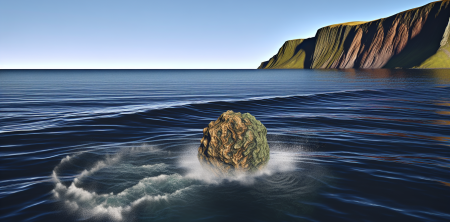
In a remarkable breakthrough, scientists have confirmed the existence of a massive asteroid impact beneath the North Sea, dating back approximately 43 to 46 million years. This significant discovery reveals the formation of the Silverpit crater, a geological feature that provides valuable insights into the history of asteroid collisions and their effects on Earth’s marine environments.
The Discovery of the Silverpit Crater
Recent seismic data combined with the analysis of shock-formed crystals have validated the hypothesis that a cosmic impact occurred in this region millions of years ago. The Silverpit crater, located beneath the seabed, stands as one of the rare underwater craters on our planet. This finding enhances the understanding of how large celestial bodies can influence geological structures and marine ecosystems.
A Historical Context for Asteroid Impacts
The Silverpit crater joins an exclusive list of significant impact sites, including the well-known Chicxulub crater in Mexico, which is famously associated with the mass extinction event that led to the demise of the dinosaurs. Similarly, the newly confirmed Silverpit crater offers a unique perspective on the dynamics of asteroid impacts in aquatic environments.
The Implications of the Impact
Scientists believe that the impact that created the Silverpit crater likely triggered a massive tsunami, reshaping the coastal landscape and affecting marine life in the vicinity. Understanding the tsunamis generated by such impacts is crucial for grasping how these events have shaped Earth’s geological history and influenced evolutionary pathways.
Advanced Analytical Techniques Illuminate the Past
To reach this significant conclusion, researchers employed advanced analytical techniques, including:
- Mineral Analysis: This method allowed scientists to study the mineralogical composition of the crater and identify the unique shock-formed crystals that indicated an impact event.
- Computational Modeling: By simulating the impact event, researchers could better understand the energy release, the resultant tsunami, and the geological formations that emerged.
These techniques have uncovered previously hidden structures, revealing the crater's size and its implications for understanding impact events.
The Geological Significance
The formation of the Silverpit crater has significant geological implications. It demonstrates how extraterrestrial impacts can create underwater structures that differ from their land-based counterparts due to the unique pressures and conditions present in marine settings. The study of this crater provides not only a window into the past but also informs scientists about the potential risks posed by future asteroid impacts.
Understanding Marine Impact Craters
Marine impact craters, such as Silverpit, are crucial for understanding how impacts differ in aquatic environments compared to terrestrial ones. The dynamics of water can significantly modify the effects of such collisions, leading to varying geological outcomes. The examination of underwater craters can help scientists piece together the history of our planet's interactions with celestial bodies.
Future Research Directions
With the confirmation of the Silverpit crater, researchers are poised to explore several avenues of inquiry:
- Impact Mechanics: Studying how impacts propagate through water and the resulting geological formations.
- Ecological Impact: Investigating how past impacts have influenced marine biodiversity and ecosystem development.
- Comparative Analysis: Examining other underwater craters to identify patterns and differences in formation and impact outcomes.
This research not only enhances our understanding of past events but also prepares us for potential future impacts.
Conclusion
The confirmation of the Silverpit crater as a result of an ancient asteroid impact marks a pivotal moment in the study of Earth’s geological history and its relationship with cosmic events. As scientists continue to unravel the mysteries of such impacts, the knowledge gained will play a significant role in understanding both our planet’s past and the potential threats it may face in the future. By studying these underwater craters, we can better appreciate the delicate balance of life on Earth and the forces that shape it.

