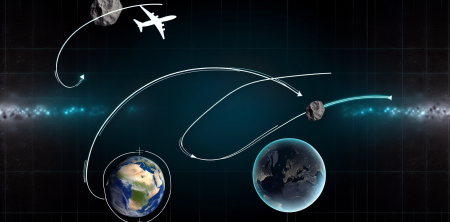
As the field of astronomy continues to evolve, NASA's recent announcement regarding two newly identified near-Earth objects has captured the attention of scientists and space enthusiasts alike. On April 27, 2026, two asteroids, designated 2026 HJ3 and 2026 HR, are set to make a close approach to Earth. While their size is comparable to that of an airplane, the agency assures us that these celestial travelers will pass millions of miles away, posing no risk to our planet.
Understanding the Asteroids: 2026 HJ3 and 2026 HR
Asteroids are remnants from the early solar system, composed primarily of rock and metal. The two asteroids in question, 2026 HJ3 and 2026 HR, have been classified as airplane-sized, which typically means they are approximately 20 to 50 meters in diameter. For context, many commercial airplanes range from about 30 to 70 meters in length. The specifics of their size and composition can significantly impact their trajectories and potential interactions with Earth.
Characteristics of 2026 HJ3
2026 HJ3 is one of the objects that will be closely monitored by astronomers. While exact measurements of its size and composition are still being studied, initial observations suggest that it is a relatively small asteroid, yet large enough to be classified among the notable near-Earth objects (NEOs). Understanding its structure can provide insights into the conditions of the early solar system.
Characteristics of 2026 HR
Similarly, 2026 HR shares characteristics with HJ3, being classified as another airplane-sized asteroid. Its close approach will provide scientists with an opportunity to gather data on its surface properties and trajectory, further enhancing our understanding of NEOs.
The Close Approach: What Does It Mean?
The term "close approach" in astronomy refers to instances when an object passes near another celestial body—in this case, Earth. However, it is essential to clarify that "close" in astronomical terms can still mean a distance of millions of miles. NASA has confirmed that during their flyby on April 27, 2026, both asteroids will not pose any risk of impact to Earth, allowing researchers to study these objects without concern for safety.
Distance of the Approach
The specific distances at which 2026 HJ3 and 2026 HR will pass from Earth have not yet been disclosed in detail. However, based on past close approaches of similar-sized asteroids, these distances are expected to be in the range of several million miles. This highlights the vastness of space, even when objects appear to be making a close approach.
Why Monitor Near-Earth Objects?
Monitoring near-Earth objects is crucial for several reasons:
- Planetary Defense: By tracking the trajectories of NEOs, scientists can assess potential risks of impact on Earth. This is a key component of planetary defense strategies, ensuring that we are prepared in the unlikely event that a hazardous asteroid is detected.
- Scientific Research: Close encounters provide an opportunity to study the composition and structure of asteroids. Understanding these remnants from the early solar system can give insights into planetary formation and the history of our cosmic neighborhood.
- Refining Orbital Models: Each close approach allows scientists to refine their orbital trajectory models, improving the accuracy of predictions about future paths of these NEOs.
The Role of NASA and International Collaboration
NASA plays a pivotal role in the global effort to monitor and understand near-Earth objects. The agency's Near-Earth Object Observations (NEOO) program collaborates with various observatories and space agencies around the world to track and characterize asteroids and comets that come close to our planet.
Technological Advances in Asteroid Tracking
Recent advancements in technology have significantly enhanced our ability to detect and monitor asteroids. Telescopes equipped with sophisticated imaging systems allow astronomers to identify and track NEOs more accurately than ever before. Software innovations have also improved the calculations related to an asteroid's trajectory, making it possible to predict future close approaches with greater precision.
Implications for Planetary Defense
The safe passage of 2026 HJ3 and 2026 HR serves as a reminder of the importance of continuous monitoring of our cosmic neighborhood. While these particular asteroids pose no threat, they represent the types of objects that could potentially be hazardous if they were on a collision course with Earth.
Preparedness Initiatives
In light of the potential risks associated with NEOs, various initiatives have been established:
- NASA's Planetary Defense Coordination Office (PDCO): This office is responsible for coordinating efforts to detect, track, and characterize NEOs. It helps to develop strategies to mitigate any potential threats.
- International Collaboration: Organizations such as the United Nations Office for Outer Space Affairs (UNOOSA) promote international collaboration on planetary defense initiatives, ensuring that all nations are prepared to respond to potential asteroid threats.
- Public Awareness Campaigns: Educating the public about NEOs and the measures in place to protect Earth is crucial. Awareness campaigns can foster a better understanding of space science and the importance of planetary defense.
The Future of Asteroid Research
The upcoming close approaches of 2026 HJ3 and 2026 HR represent only a fraction of the ongoing exploration of asteroids. As technology continues to advance, the capability to study these objects will expand, leading to new discoveries about their origins and potential resources.
Impacts on Space Exploration
In addition to their scientific significance, asteroids are increasingly recognized for their potential as resources for future space exploration. They may contain valuable materials, including metals and water, which could support long-term human missions to the Moon, Mars, and beyond.
Conclusion: Looking Ahead
As we approach April 27, 2026, all eyes will be on the skies as 2026 HJ3 and 2026 HR make their close approaches to Earth. While the asteroids will pass safely by, they offer an invaluable opportunity for scientific research and education. By studying these celestial objects, we can enhance our understanding of the solar system and improve our planetary defense strategies.
In the ever-evolving landscape of space exploration, each close encounter with near-Earth objects serves as a reminder of the delicate balance between our planet and the vast cosmos. As we look to the future, collaboration, innovation, and vigilance will be essential in our ongoing quest to understand and protect our home in the universe.

