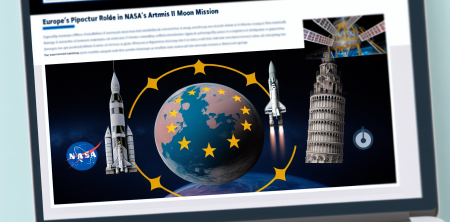
The exploration of space has always been a collaborative endeavor, but as we look towards the Moon and beyond, the partnership between NASA and the European Space Agency (ESA) is set to play a crucial role in the upcoming Artemis II mission. With the launch slated for 2026, this mission will mark humanity's return to lunar exploration, and at the heart of this mission lies the European Service Module (ESM).
Understanding the European Service Module
The European Service Module is an essential component of NASA's Artemis II mission, designed to provide the necessary propulsion, power, and life support systems for a crewed journey around the Moon. As the mission aims to send astronauts beyond low Earth orbit, the ESM's capabilities are critical for ensuring the safety and efficiency of deep space operations.
Key Functions of the ESM
The ESM is not just a mere accessory to the mission; it is a sophisticated piece of engineering that fulfills several vital functions:
- Propulsion: The ESM is equipped with an array of thrusters that will guide the Orion spacecraft on its journey to the Moon. This propulsion system is essential for maneuvering in the vacuum of space.
- Power Supply: The module generates and stores energy to power the spacecraft's systems and support the astronauts on their mission. Solar panels will harness energy from the Sun, ensuring that all onboard systems remain operational.
- Life Support: The ESM is designed to maintain a habitable environment for astronauts. This includes providing oxygen, managing carbon dioxide levels, and regulating temperature and humidity.
Significance of the Artemis II Mission
Scheduled to follow the uncrewed Artemis I mission, Artemis II will be the first crewed test flight of the Orion spacecraft. This mission represents a significant step towards returning humans to the Moon, paving the way for future lunar exploration and potential colonization. The Artemis program aims not only to land astronauts on the Moon but also to establish a sustainable human presence there.
Technical Achievements of the ESM
The development of the ESM is a testament to the engineering prowess of the European Space Agency. Key achievements include:
- Collaboration: The ESM has been developed through international collaboration, with contributions from various European countries, showcasing the importance of teamwork in space exploration.
- Advanced Technology: The module incorporates cutting-edge technology, including autonomous systems that allow it to operate independently during the mission.
- Testing and Validation: Prior to its deployment in Artemis II, the ESM underwent rigorous testing to ensure its reliability and performance in the harsh conditions of space.
Public Engagement and Interest
Since its release on March 27, 2026, the ESA video detailing the ESM’s role in the Artemis II mission has attracted considerable attention, garnering over 543 views and 36 likes. This engagement reflects a growing public interest in lunar exploration and the technological advancements that make it possible.
Future Implications for Space Exploration
The successful operation of the ESM during the Artemis II mission will have far-reaching implications for future missions beyond our Moon. As NASA and ESA look towards Mars and other celestial bodies, the lessons learned from the ESM’s performance will inform the design and engineering of future spacecraft.
Conclusion
The European Service Module is more than just a component of the Artemis II mission; it is a symbol of international collaboration and innovation in space exploration. As astronauts prepare to make their journey around the Moon, the ESM will play a critical role in ensuring their safety and success. With each advancement in technology and every mission launched, humanity takes another step toward understanding our universe and our place within it.
As we stand on the brink of this new era in space exploration, the partnership between NASA and ESA serves as a reminder of what can be achieved when nations come together to pursue a common goal—unlocking the mysteries of the cosmos.

