```html
Understanding Irreversibility in Cognitive Development
Irreversibility in problem-solving refers to a child's inability to mentally reverse a sequence of events or operations. This concept is rooted in developmental psychology and was notably highlighted by psychologist Jean Piaget in his theory of cognitive development. According to Piaget, children in the preoperational stage (ages 2 to 7) struggle with understanding that actions can be undone or reversed. For instance, if a child sees a ball of clay flattened, they may not comprehend that it can be reshaped back into a ball. This cognitive limitation can significantly influence how young children approach problem-solving tasks.
The Role of Irreversibility in Early Childhood Learning
In early childhood education, recognizing the role of irreversibility is crucial. Children often face challenges when they encounter problems that require reversible thinking. As they engage with the world around them, they begin to learn that many processes are reversible. However, during the preoperational stage, they might not apply this understanding consistently. For educators and parents, it is essential to create environments that encourage exploration and experimentation. Activities like play-dough manipulation or water pouring can help children observe reversibility in action, fostering their cognitive development.
Piaget’s Theory and Irreversibility
Jean Piaget categorized cognitive development into four main stages, with the preoperational stage serving as a critical period for understanding irreversibility. During this time, children exhibit a variety of thought processes, yet their inability to reverse actions limits their problem-solving efficacy. For example, a young child might be asked to compare two different sizes of containers filled with the same amount of liquid. While they may see the liquids are equal, they might struggle to understand that pouring one into the other will yield the same volume. This inability to mentally revert to a previous state reflects their grasp of irreversibility.
Practical Examples of Irreversibility in Action
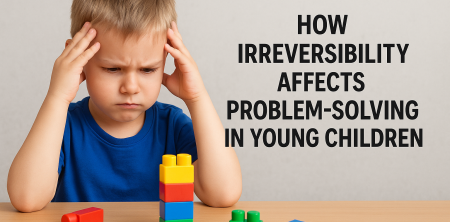
Consider a scenario where a child plays with building blocks. If they build a tower and subsequently knock it down, they may not immediately understand that they can rebuild it. This is a clear demonstration of irreversibility affecting their problem-solving skills. In contrast, as children develop, they begin to recognize that they can change their actions and return to a previous state. Activities like sorting objects by color or shape may also show irreversibility, as they may initially struggle with the concept that the arrangement can be altered and restored to a previous configuration.
Supporting Children in Overcoming Irreversibility
To help children overcome the challenges posed by irreversibility, caregivers and educators can employ various strategies. Encouraging play-based learning can be particularly effective. For example, using role-play scenarios where children can act out different situations allows them to practice reversing actions. Additionally, involving children in cooking or crafting activities can provide tangible experiences with transformation and reversal. By guiding them through processes where they can observe and predict outcomes, adults can support their understanding of cause and effect.
The Importance of Language in Understanding Irreversibility
Language plays a vital role in helping children grasp the concept of irreversibility. When adults engage children in discussions about their activities — describing processes and outcomes — it reinforces their cognitive understanding. Phrases like "Let's see what happens when we put this back together" can prompt children to think about the reversibility of actions. Encouraging children to articulate their thought processes can also deepen their understanding, as they are forced to reflect on their actions.
Current Research on Irreversibility and Problem-Solving
Recent studies in cognitive psychology continue to explore how irreversibility affects problem-solving in young children. Researchers have conducted experiments that demonstrate how children’s inability to reverse actions impacts their approach to tasks. For instance, studies reveal that children exposed to activities focused on reversibility, such as block building or puzzle assembly, show improved problem-solving skills over time. This highlights the importance of incorporating such educational strategies in early learning environments. (See: Cognitive development overview.)
Comparative Analysis: Irreversibility Across Different Cultures
Interestingly, the understanding of irreversibility may vary across cultures. In some cultures, children are encouraged to engage in more experiential learning, which may foster a deeper understanding of reversible processes. For example, children who frequently participate in hands-on activities that involve natural materials may develop a more nuanced understanding of transformation. This cultural context can greatly affect how children perceive and address problem-solving scenarios.
Long-Term Implications of Irreversibility in Problem-Solving
The implications of irreversibility in problem-solving extend beyond early childhood. As children grow, the foundational skills they develop during these formative years can influence their academic and social abilities. Children who learn to navigate irreversibility may approach challenges with greater resilience, adaptability, and creativity. As they progress through school, the ability to understand reversible actions can enrich their mathematical and scientific reasoning, making it vital for educators to address these concepts early.
Strategies to Encourage Reversible Thinking
To nurture reversible thinking in children, practitioners can implement various strategies. One effective method is through guided play. Using games that require children to make decisions and reflect on the consequences encourages them to think critically about their actions. For instance, playing chess or simple board games can help children understand how their moves can be reversed and what the outcomes may be. These activities reinforce the idea that many actions can have multiple consequences, enhancing their problem-solving abilities.
Case Studies in Educational Settings
Several educational institutions have adopted innovative approaches to tackle irreversibility in problem-solving. One notable example is the use of project-based learning in preschools, where children engage in projects that require them to brainstorm, execute, and iterate on ideas. For example, a project focused on creating a community garden allows children to plan, plant, and then later reflect on their growth process. When they see what happens when plants thrive or fail, they grasp the concept of reversibility through observation and real-life application.
Expert Perspectives on Irreversibility in Problem-Solving
Experts in child psychology emphasize the importance of addressing irreversibility early in educational settings. Dr. Emily Rosenthal, a child development specialist, states, “Understanding the concept of reversibility is not just about academic learning; it shapes how children perceive challenges and setbacks in life. If they can understand that they can change, adapt, and return to a previous state, they develop resilience.” This perspective highlights the link between cognitive skills and emotional intelligence, suggesting that a strong grasp of irreversibility can support better coping mechanisms in children.
Statistics on Cognitive Development and Irreversibility
Recent surveys and studies in early childhood education reveal some compelling statistics related to irreversibility. A study by the Journal of Educational Psychology found that children who engaged in activities emphasizing reversibility showed a 30% increase in problem-solving skills compared to those who did not. Furthermore, a longitudinal study indicated that children who understood the concept of reversibility early in their educational journey tended to outperform their peers in mathematics by approximately 20% by the time they reached elementary school.
Frequent Questions About Irreversibility in Problem-Solving
What age do children typically start to understand reversibility?
Children begin to understand the concept of reversibility around the age of 7, moving into the concrete operational stage of cognitive development according to Piaget. However, many factors, including environmental influences and educational experiences, can impact this timeline. (See: Learning and cognitive development.)
How can parents help reinforce the concept of reversibility at home?
Parents can reinforce reversibility by incorporating games and activities that require thinking ahead and backtracking choices. Simple activities like building and rebuilding with blocks or playing games that involve undoing moves can provide practical experiences that deepen their understanding.
Are there specific toys or materials that facilitate learning about irreversibility?
Yes, toys like building blocks, shape sorters, and puzzles can help children explore the concept of reversibility. Additionally, art supplies that allow for mixing and re-shaping materials, such as clay or kinetic sand, can provide hands-on opportunities for children to learn through play.
How does understanding irreversibility impact future learning and skills?
Understanding irreversibility is foundational for complex problem-solving. It helps children develop logical reasoning skills and adaptability, which are crucial for subjects such as mathematics and science. Moreover, it can enhance their ability to cope with challenges later in life, as they learn to view setbacks as reversible rather than permanent failures.
Can irreversibility affect social interactions as well?
Absolutely. Children who struggle with understanding irreversibility may also face challenges in social situations, as they might not fully grasp the consequences of their actions or words. As they learn to navigate these concepts, they can develop more effective communication and interpersonal skills.
Enhancing Understanding of Irreversibility in Problem-Solving
To deepen children's understanding of irreversibility, education professionals can integrate specific methodologies that emphasize experiential learning. For example, interactive science experiments where children can mix substances and then attempt to separate them can vividly illustrate irreversibility. Learning about chemical reactions provides not only an insight into the physical changes but also a metaphor for understanding how actions may lead to irreversible consequences.
Real-Life Applications of Reversible and Irreversible Processes
Recognizing reversible and irreversible processes extends beyond academic settings into everyday life. For instance, in cooking, many children observe how certain ingredients combine to create a dish that can't easily be returned to its original state, such as when baking a cake. This serves as a tangible example of irreversibility. On the other hand, activities like melting and refreezing ice provide a clear visual of reversible processes, aiding children in grasping these concepts through real-life contexts.
Encouraging Critical Thinking Through Irreversibility
Critical thinking can be fostered by challenging children to question reversibility in different contexts. Presenting them with moral dilemmas or scenarios that require them to consider the outcomes of their decisions can lead to significant cognitive growth. For instance, if a child engages in a scenario where they must choose whether to share a toy, discussing the potential 'reversible' nature of their choice can help solidify their understanding of consequence and decision-making.
Integrating Technology in Teaching Irreversibility
In our tech-savvy world, integrating technology into learning can enhance children's grasp of complex concepts like irreversibility. Interactive applications and games designed for young learners often feature scenarios where players must solve problems that require reversing actions. Such digital platforms can provide immediate feedback, helping children understand the links between their choices and their outcomes. Educational games that simulate real-world situations encourage learners to experiment with cause and effect in a controlled environment.
Future Research Directions on Irreversibility
As education evolves, understanding how children learn about irreversibility remains an important area of research. Future studies may explore how different teaching methods – from traditional classrooms to online learning environments – impact children's cognitive development concerning irreversibility. There's also a potential for examining how socio-emotional factors intertwine with cognitive skills to influence problem-solving abilities. This can provide further insights into developing comprehensive educational strategies that address both cognitive and emotional growth.
Conclusion: The Path Forward in Understanding Irreversibility
Understanding irreversibility in problem-solving is crucial for fostering cognitive development in young children. By providing supportive learning environments and engaging experiences, adults can help children develop the skills necessary to navigate complex problems. As research continues to uncover the nuances of cognitive growth, it is essential for parents, educators, and researchers to collaborate on strategies that mitigate the effects of irreversibility. Encouraging reversibility not only aids in problem-solving but also enriches a child’s overall educational journey.
```
Trending Now
Frequently Asked Questions
What is irreversibility in child development?
Irreversibility in child development refers to a young child's inability to mentally reverse a sequence of actions or events. This concept, highlighted by psychologist Jean Piaget, is particularly evident in children aged 2 to 7, who may struggle to understand that some actions can be undone, impacting their problem-solving skills.
How does irreversibility affect problem-solving in children?
Irreversibility affects problem-solving in children by limiting their ability to think backward through a sequence of events. This cognitive limitation means that young children may not recognize that certain actions can be reversed, which can hinder their understanding of tasks that require reversible thinking.
What are the stages of cognitive development according to Piaget?
According to Jean Piaget, cognitive development occurs in four stages: sensorimotor (birth to 2 years), preoperational (2 to 7 years), concrete operational (7 to 11 years), and formal operational (11 years and up). The preoperational stage is crucial for understanding concepts like irreversibility.
What activities can help children understand reversibility?
Activities that promote understanding of reversibility include play-dough manipulation, water pouring, and other hands-on experiments. These activities allow children to explore and observe how certain actions can be undone, fostering their cognitive development and problem-solving abilities.
Why is it important to understand irreversibility in education?
Understanding irreversibility is important in education because it helps educators and parents create supportive learning environments. By recognizing this cognitive limitation, they can design activities that encourage exploration and experimentation, ultimately aiding children's problem-solving skills during their critical developmental stages.
Have you experienced this yourself? We'd love to hear your story in the comments.

