```html
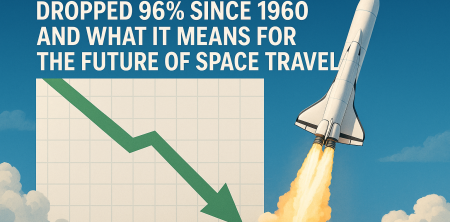
Space exploration has always been a subject of fascination, from the thrilling tales of astronauts to the awe-inspiring images of distant galaxies. Yet, for many years, a significant barrier stood in the way of widespread access to space: the high costs associated with launching rockets. Recent studies have unveiled a shocking trend: rocket launch costs have decreased by a staggering 96% since 1960. This reduction not only changes the landscape of space travel but also ignites curiosity about how low these costs can go in the future.
1. The Dramatic Decline of Rocket Launch Costs
In 1960, the average cost of sending one kilogram into orbit was a monumental $87,023. Fast forward to 2025, and that figure is expected to plummet to just $3,868. This nearly century-long journey reveals the impact of technological advancements and the rise of private space ventures. The drop in costs can be attributed to several factors, including reusable rocket technology and increased competition among private space companies.
One standout example is SpaceX, which has pioneered the development of reusable rockets, significantly reducing the expense of launching payloads into orbit. The Falcon 9 rocket, designed to return to Earth for refurbishment and reuse, exemplifies how these advancements are reshaping the economics of space travel. The success of such innovations has led to a wave of optimism regarding the future trajectory of rocket launch costs.
2. Predicting Future Costs: What's Next?
Researchers are not stopping at the current projections. They anticipate that by 2030, the cost to send a kilogram into orbit could drop even further to around $1,600. This potential reduction is driven by continuous improvements in technology, the scaling of manufacturing processes, and the ongoing expansion of the commercial space sector. As more companies enter the market, the costs are likely to be driven down even further.
Looking even further ahead, experts speculate that by 2040, costs could fall to an astonishing $300 per kilogram. This would revolutionize the accessibility of space, allowing not just governments and large corporations but also smaller enterprises and even individuals to consider space exploration seriously. Such projections paint a picture of a future where space is not just a domain for the elite but a frontier accessible to all.
3. The Implications for Space Accessibility
The dramatic drop in rocket launch costs signifies a fundamental shift in how we view space travel. Historically, the high costs associated with launching payloads created an elite club of nations and corporations capable of reaching the stars. However, as costs decline, the barriers to entry are diminishing. This opens the doors for a broader range of participants in the space economy.
The implications are profound. More organizations, including startups and universities, can conduct research and experiments in space. This democratization of space travel can lead to increased innovation and diversity in approaches to solving complex problems, such as climate change, resource management, and even space colonization.
4. How Does This Compare to Historical Context?
To appreciate the significance of the current trends in rocket launch costs, it’s essential to consider the historical context. The 1960s were characterized by the space race, where immense resources were poured into developing the technology necessary to send humans to the Moon. The budget of NASA and its competitors during this time was staggering compared to today’s expenditures. The original Apollo program, for example, cost around $25 billion (adjusted for inflation, that’s over $150 billion today).
Now, we’re witnessing a shift where private enterprises are taking on roles traditionally held by government agencies. The rise of companies like SpaceX, Blue Origin, and Rocket Lab has introduced a new competitive edge that drives innovation and lowers costs. In many ways, this mirrors the tech boom in Silicon Valley, where competition and innovation led to an explosion of technological advancement and accessibility.
5. Breaking Down the Cost Factors
Understanding the factors that contribute to the costs associated with rocket launches helps illuminate why these prices are falling. First, the development of reusable rocket technology is a game changer. By successfully landing and reusing rockets, companies are saving considerable amounts that would have otherwise been spent on manufacturing new rockets for each launch.
Secondly, economies of scale play a significant role. As companies ramp up their operations and launch more frequently, the cost per launch decreases. The infrastructure costs associated with launching rockets—such as ground facilities—can be spread over more launches, reducing the average cost of each individual launch. Additionally, advances in materials science and engineering techniques have led to lighter, stronger rockets that are cheaper to produce. (See: SpaceX and its reusable rockets.)
6. The Role of Government and Regulation
Government policy and regulation also play pivotal roles in shaping the landscape of rocket launch costs. In many countries, supportive policies have led to the flourishing of private space companies. For instance, in the United States, the FAA (Federal Aviation Administration) has streamlined regulations for commercial space launches, making it easier for companies to enter the market.
Moreover, government contracts can provide a stable revenue source for private companies, which helps them invest in research and development. This creates a virtuous cycle where government support leads to lower costs and increased innovation, which in turn leads to more government contracts as missions become more feasible and affordable.
7. Investor Interest in Lower Launch Costs
As the costs of rocket launches continue to tumble, investor interest in the space sector is surging. The prospect of accessing space at lower prices is enticing not only for potential space tourism but also for satellite deployment, scientific research, and more. Investors are increasingly looking at companies that are innovating in this field.
Venture capitalists are betting on the future of space travel, with billions of dollars flowing into startups focused on developing new technologies that further reduce launch costs. The combination of technological advancement and investor confidence creates a scenario where innovative solutions can be rapidly developed and deployed, leading to even more reductions in launch prices.
8. Space Tourism: A New Frontier
Perhaps one of the most exciting outcomes of reduced rocket launch costs is the potential for space tourism. Companies like Virgin Galactic and Blue Origin are already working on making suborbital flights accessible to civilians. As launch costs decrease further, the dream of vacationing in space might not be as far-fetched as it once seemed.
Imagine a future where a trip to space could be as accessible as a first-class flight. With costs dropping, the dream of experiencing weightlessness and seeing Earth from above could become a reality for many. This would not only change the travel industry but also cultivate a new generation of enthusiasts passionate about space exploration.
9. Educational and Research Opportunities
Beyond tourism, the new price landscape is set to open up numerous educational and research opportunities. Universities and research institutions can explore the possibility of conducting experiments in microgravity without the burden of excessive costs. This can lead to breakthroughs in various scientific fields, from biology to materials science.
Moreover, educational programs could emerge that allow students to participate in actual space missions, fostering interest in STEM careers. As more students engage with space travel and exploration, the next generation of scientists and engineers could rise, ultimately benefiting society through their innovations.
10. Exploring the Economic Impact of Lower Launch Costs
The decline in rocket launch costs doesn’t just affect space missions; it has broader economic implications as well. Lower launch costs enable the establishment of new businesses in the space sector, including satellite communications, Earth observation, and even asteroid mining. These sectors can generate billions in revenue and create jobs in engineering, manufacturing, and related fields.
According to the Space Foundation, the global space economy was valued at approximately $423 billion in 2019, and this figure is expected to grow exponentially as launch costs decrease. For instance, the satellite industry alone is projected to be worth over $1 trillion by the early 2030s, driven by advancements in launch technology and the increasing demand for satellite services.
Additionally, countries that invest in their space capabilities can expect to see an increase in their global standing and influence. Nations like India and China have already used lower launch costs to enhance their capabilities and assert their positions in the space race, paving the way for potential partnerships and collaborations.
11. Challenges and Risks Ahead
While the future looks promising, there are still challenges and risks associated with the rapidly evolving landscape of rocket launch costs. The competition among private companies could lead to a "race to the bottom," where safety and reliability are compromised in favor of cutting costs. It's essential that companies prioritize safety as they innovate, ensuring that low-cost solutions do not come at the expense of rigorous testing and quality control. (See: NASA's launch systems lifecycle.)
Furthermore, as more entities enter the space market, the risk of overcrowding in orbit increases. Space debris is becoming a significant concern, and the proliferation of satellites could exacerbate the problem, potentially leading to catastrophic collisions. Addressing these challenges will require cooperation and regulation among countries and organizations involved in space exploration.
12. FAQ: Rocket Launch Costs
What are the main factors driving down rocket launch costs?
Key factors include reusable rocket technology, economies of scale, advancements in materials and manufacturing techniques, and increased competition among private companies.
How much has the cost of launching a rocket decreased?
Since 1960, rocket launch costs have decreased by about 96%, from approximately $87,023 per kilogram to an expected $3,868 by 2025.
Will space tourism become affordable for the average person?
As launch costs continue to decline, space tourism is becoming more feasible. Companies like Blue Origin and Virgin Galactic are working towards making suborbital flights available to civilians, potentially making space travel accessible to a broader audience in the near future.
How will reduced launch costs impact the global economy?
Lower launch costs can stimulate the space economy, leading to the emergence of new businesses and sectors, generating jobs, and increasing a nation's global influence in space technology and exploration.
What are the potential risks of reduced costs?
While lower costs promote innovation, risks include compromised safety standards and increased space debris from an overcrowded orbital environment. It’s crucial for companies and governments to work together to mitigate these risks.
13. A Vision for the Future
The future of rocket launch costs holds vast potential for transforming not just space exploration but also life on Earth. Imagine the applications of space-based solar power, which could provide energy to remote locations and significantly reduce our carbon footprint. Or the ability to send humanitarian aid quickly via satellites, which could reach the most isolated areas of the planet.
As we embrace a new era where the final frontier becomes more accessible, the possibilities are endless. The technological innovations driven by the quest for lower launch costs will likely spill over into other industries, leading to advancements that we can't yet envision. We are on the brink of a new chapter in human capability, one that could redefine our relationship with space and each other.
14. Challenges in Achieving Lower Rocket Launch Costs
While the decline in rocket launch costs paints an optimistic picture for the future, several challenges remain in achieving even lower costs. One significant hurdle is the high initial investment required for research and development. Developing new technologies, such as advanced propulsion systems or reusable components, requires substantial financial backing. Startups may struggle to secure funding, which could delay innovations that further reduce costs.
Additionally, the space industry is still grappling with the complexities of supply chain management. Shortages of critical materials, such as specific alloys or composites used in rocket manufacturing, can impact production timelines and costs. As demand for launches increases, supply chain disruptions could lead to higher prices, countering the trend of decreasing costs. (See: Economic analysis of launch costs.)
15. The Role of International Collaboration
International collaboration is also crucial for reducing rocket launch costs. Space is a global endeavor, and pooling resources can lead to more efficient and cost-effective missions. By sharing technology and expertise, countries can work together to develop standard practices that streamline the launch process. For instance, the European Space Agency (ESA) collaborates with various nations on projects that can benefit from shared knowledge and reduced duplication of efforts.
Cooperative missions can also lead to lower costs by combining funding sources. The Artemis program, aimed at returning humans to the Moon, involves partnerships between NASA and space agencies from around the world, which spreads the financial burden and enhances technological sharing. Such collaborations not only reduce costs but also strengthen diplomatic ties among nations.
16. Environmental Considerations of Rocket Launches
As we look forward to a future with more frequent rocket launches, it’s essential to consider the environmental impact. Rocket launches can produce significant emissions that contribute to atmospheric pollution. As the demand for launches increases, so does the urgency to develop greener propulsion technologies that minimize the carbon footprint of space travel.
Innovations such as electric propulsion and biofuels are being explored as alternatives to traditional rocket fuels that emit harmful gases. Companies like Green Space Ventures are actively researching ways to reduce the environmental impact of launches while maintaining efficiency and safety. The goal is not only to make space more accessible but also to ensure that our activities in space do not harm our planet.
17. The Social Impact of Lower Launch Costs
The social implications of declining rocket launch costs are profound. As access to space becomes more democratized, we can expect an increase in public engagement with space exploration. Educational initiatives aimed at inspiring interest in science and technology will likely grow, as schools and community programs take advantage of the new opportunities available in the space sector.
This increased engagement can lead to a more informed public that advocates for scientific research and supports policies favoring space exploration. Moreover, as costs decline, we may witness a renaissance of public interest in astronomy and space science, similar to the enthusiasm seen during the Apollo era.
18. Conclusion: A New Era of Space Exploration
Rocket launch costs have undergone an astonishing transformation, dropping by 96% since 1960. This trend not only marks a significant advancement in technology but also signals a new era of accessibility in space travel. As costs continue to decline, we can expect to see an influx of participants in the space economy, from startups to universities, and even everyday individuals. The future is bright, and the barriers that once kept humanity from the stars are slowly but surely disappearing.
```
Trending Now
Frequently Asked Questions
How much have rocket launch costs decreased since 1960?
Rocket launch costs have decreased by a staggering 96% since 1960. In 1960, the average cost to send one kilogram into orbit was $87,023, but this is projected to drop to just $3,868 by 2025.
What factors have contributed to the reduction in rocket launch costs?
The significant reduction in rocket launch costs can be attributed to advancements in technology, particularly reusable rocket technology, and increased competition among private space companies like SpaceX, which has pioneered the development of reusable rockets.
What is the expected cost of launching a rocket in 2030?
By 2030, researchers predict that the cost to send a kilogram into orbit could drop to around $1,600. This reduction is expected due to ongoing technological improvements and the expansion of the commercial space sector.
How has SpaceX impacted rocket launch costs?
SpaceX has significantly impacted rocket launch costs by developing reusable rockets, such as the Falcon 9. This innovation allows rockets to return to Earth for refurbishment, drastically lowering the expense of launching payloads into orbit.
What does the future hold for space travel costs?
The future of space travel costs looks promising, with experts optimistic that continuous advancements in technology and increased market competition will drive costs down even further, making space more accessible than ever.
What did we miss? Let us know in the comments and join the conversation.

