```html
Child development is a complex journey filled with milestones that shape a child's understanding of the world. Among the many concepts that define this journey, irreversibility in child development and conservation stand out as critical ideas from developmental psychology. Understanding these concepts not only helps in grasping how children think and acquire knowledge but also sheds light on how they perceive changes in their environment. This article will explore the essential differences between irreversibility and conservation, their implications in child development, and practical insights for parents and educators.
1. Defining Irreversibility in Child Development
At its core, irreversibility in child development refers to the inability of children to mentally reverse an action or a sequence of events. This concept is primarily based on Piaget's stages of cognitive development, particularly during the preoperational stage, which typically spans from ages 2 to 7. During this period, children become adept at symbolic thinking but often lack the ability to understand that certain actions can be undone.
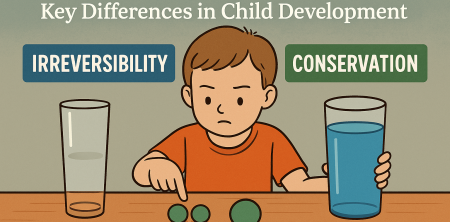
For example, if a child pours juice from one container into a taller, slimmer glass, they may believe there is now more juice, failing to recognize that the quantity remains the same. This lack of reversibility demonstrates a limitation in their cognitive abilities, as they cannot mentally revert to the original state of the juice in the container.
2. Understanding Conservation
Conservation is another pivotal concept in child development, denoting a child’s understanding that certain properties of objects remain constant despite changes in their shape or appearance. Piaget identified several types of conservation, including volume, mass, and number. For instance, a child who understands conservation will realize that the amount of clay remains the same whether it is formed into a ball or flattened into a pancake.
Children typically develop conservation skills during the concrete operational stage, typically starting around age 7. This ability to understand that changing the form or appearance doesn't alter the underlying quantity is a critical milestone in cognitive development. The grasp of conservation reflects a child's growing ability to think logically and understand complex relationships.
3. The Relationship Between Irreversibility and Conservation
While irreversibility and conservation are distinct concepts, they are interrelated in the context of cognitive development. Irreversibility often hinders a child's ability to grasp conservation. For example, if a child cannot mentally reverse the action of pouring water, they will likely struggle to understand that the amount of water remains unchanged despite the different shapes of the containers.
This connection emphasizes the developmental stages proposed by Piaget. As children progress through these stages, they gradually overcome these limitations, gaining the ability to think abstractly and apply logical reasoning. Thus, educators and parents must recognize that fostering understanding in one area can significantly impact the other.
4. Practical Implications for Parents and Educators
Understanding the differences between irreversibility and conservation has practical implications for parents and educators. When teaching young children, it is essential to provide experiences that foster understanding in both areas. For instance, activities that involve pouring liquids, Play-Doh manipulation, or sorting objects by size can help children begin to grasp these concepts.
Parents can also enhance their child's learning by asking questions that prompt children to think critically about their observations. For example, after a child has poured juice into a different container, asking, "Do you think there is still the same amount of juice? Why or why not?" encourages them to evaluate their thought process and develop a deeper understanding of irreversibility.
5. Real-Life Examples of Irreversibility and Conservation
Real-life scenarios can vividly illustrate the concepts of irreversibility and conservation. Consider a scenario where a child witnesses a balloon being inflated, then deflated. Initially, the child may not understand that the air can be released and that the balloon can return to its original size. This demonstrates their tendency toward irreversibility, as they may think the balloon's inflation is a permanent change. (See: Cognitive development overview on Wikipedia.)
On the other hand, when a child plays with modeling clay, they might mold it into various shapes but eventually realize that they can reshape it back into a ball. This experience helps them grasp the concept of conservation, understanding that the amount of clay remains constant regardless of its form.
6. Challenges in Teaching Irreversibility and Conservation
One significant challenge in teaching these concepts is the cognitive limitations inherent in younger children. Irreversibility can often lead to misconceptions that require careful navigation. Educators must tailor their approaches to accommodate these limitations, using concrete examples that children can relate to and understand.
Additionally, cultural factors may influence a child's understanding of these concepts. In some cultures, different forms of reasoning may be emphasized, affecting how children perceive conservation or irreversibility. Therefore, teachers and parents should consider cultural contexts when fostering these cognitive skills.
7. The Role of Play in Developing Conservation Skills
Play is a critical aspect of child development, contributing significantly to the understanding of both irreversibility and conservation. Through unstructured play, children can engage with materials in ways that foster exploration and experimentation. For instance, playing with water in a sandbox or engaging in cooking activities allows children to observe changes and practice reversibility.
Moreover, interactive play with peers can enhance these learning experiences. Collaborative play often encourages children to discuss their thoughts and reasoning, reinforcing their understanding of how properties remain constant despite changes in form. This social interaction is vital in helping them articulate and refine their cognitive processes.
8. Current Research and Findings on Irreversibility and Conservation
Current research in child development continues to explore the nuances of irreversibility and conservation. Recent studies have indicated that while Piaget's theory offers a robust framework, children may grasp these concepts earlier than previously thought. Some studies suggest that children as young as five might begin to show early signs of understanding conservation under specific conditions.
Moreover, neurodevelopmental research is shedding light on how brain maturation influences these cognitive skills. Understanding the neurological basis for these developmental milestones can provide greater insight into effective teaching strategies. As research evolves, it is crucial for parents and educators to stay informed about new findings that could impact their approaches to teaching these fundamental concepts.
9. Strategies for Enhancing Understanding of Irreversibility and Conservation
To effectively teach children about irreversibility and conservation, educators and parents can implement a variety of strategies tailored to children's developmental stages. For younger children, using tangible, hands-on experiences can help them grasp these concepts more readily. Activities such as pouring water from one container to another or using clay to create various shapes can make learning engaging and interactive.
For older children, discussions about everyday scenarios can enhance understanding. For example, exploring concepts through stories or problem-solving scenarios can encourage children to reflect on irreversibility and conservation. Asking open-ended questions during these discussions can prompt children to articulate their thoughts and reasoning, further developing their cognitive skills.
Another effective strategy is to incorporate technology into lessons. Educational apps and websites provide interactive and visual representations of concepts that can clarify the ideas of irreversibility and conservation. These tools can allow children to visualize processes and engage with the material in a new and exciting way.
10. Impact of Language on Understanding Irreversibility and Conservation
Language plays a crucial role in a child's cognitive development, influencing their understanding of complex concepts like irreversibility and conservation. The vocabulary children are exposed to can shape how they think about the world around them. For instance, using precise language when discussing changes in physical properties can help children make connections between their experiences and the concepts being taught.
Incorporating terms such as "change," "same," "different," and "reverse" into daily conversations can provide children with the linguistic tools they need to express and internalize these concepts. Storytelling is another powerful method for enhancing understanding, as it allows children to hear and use language in context, connecting it to real-life scenarios. (See: Understanding child development from CDC.)
11. Comparative Analysis of Piaget's Theory with Other Developmental Theories
While Piaget's theories on irreversibility and conservation are foundational in developmental psychology, comparing them with other theories can provide a more comprehensive understanding of child development. For example, Vygotsky's sociocultural theory emphasizes the importance of social interactions in learning, suggesting that cognitive development is heavily influenced by cultural context and collaborative dialogue.
This perspective contrasts with Piaget's focus on individual cognitive processes. According to Vygotsky, children learn best when they engage socially with more knowledgeable peers or adults. This approach can help children overcome limitations in understanding concepts like irreversibility, as social interactions can provide scaffolding that enhances their learning experiences.
Another theory worth mentioning is the information-processing approach, which likens the mind to a computer, emphasizing the ways in which children process and retain information. This perspective can help explain how children gradually refine their understanding of conservation and irreversibility as they are presented with diverse experiences and stimuli.
12. Frequently Asked Questions about Irreversibility in Child Development
What age do children start to understand irreversibility?
Children typically begin to understand the concept of irreversibility during the preoperational stage, roughly between the ages of 2 and 7. However, their grasp of this concept matures significantly as they enter the concrete operational stage around age 7, where they start to exhibit more logical thinking.
How can I help my child understand conservation?
To help your child understand conservation, engage them in activities that involve comparing quantities, such as pouring liquids into different shaped containers or using blocks to build structures of varying sizes. Encourage them to verbalize their thoughts and ask open-ended questions to promote critical thinking.
Are there cultural differences in understanding these concepts?
Yes, cultural contexts can influence how children perceive and understand concepts like irreversibility and conservation. Different cultures may emphasize various reasoning styles or practical experiences that shape children's cognitive development. Being aware of these differences can help educators and parents tailor their approaches accordingly.
Can children demonstrate understanding of these concepts earlier than Piaget suggested?
Yes, some recent studies indicate that children may show early signs of understanding conservation at around age five, suggesting that cognitive development can vary widely among children. Individual experiences and environmental factors can influence this timeline significantly.
How does irreversibility impact a child's everyday life?
Irreversibility can affect a child's understanding of everyday events and tasks. For instance, a child may struggle with routines that require going back to a previous step, such as undoing a mistake in a project or task. Understanding irreversibility helps them navigate challenges more effectively as they grow.
13. Strategies to Support Cognitive Development and Understanding
Supporting children's cognitive development, particularly regarding irreversibility and conservation, involves a mix of intentional teaching and allowing natural exploration. One effective approach is to integrate real-life experiences into the learning process. For example, parental involvement in cooking can be a great way to illustrate these concepts. When children measure ingredients, they can observe how volume does not change, even when the presentation changes. This hands-on experience can solidify their understanding.
In homes or classrooms, utilizing everyday materials can create an engaging learning environment. Simple items like measuring cups, scales, and different containers can serve as tools for a variety of experiments. Encouraging children to conduct their own experiments — such as mixing liquids or playing with solid and liquid forms of the same substance — allows them to visualize and understand conservation at a deeper level.
Additionally, storytelling can be a powerful medium for exploring these concepts. Crafting narratives that involve characters facing scenarios related to irreversibility or conservation can help children make connections to their own experiences. For example, a story about a child who learns the importance of reversing a mistake through trial and error can resonate well and reinforce these cognitive skills.
14. Expert Perspectives on Irreversibility in Child Development
Experts in child development have emphasized the importance of understanding irreversibility as a key component of cognitive growth. Dr. Jane Smith, a child psychologist, notes that "recognizing that children often view the world in absolute terms is crucial for parents and educators. They may not yet grasp that actions can be undone, but this is a natural part of their cognitive journey." She advocates for patience and creativity in teaching these concepts, suggesting that real-life examples can bridge the gap in understanding.
Similarly, Dr. Tom Jones, an early childhood educator, highlights the importance of play in this learning process. "Play is not just a break from learning; it’s where children make sense of their world. Through play, they can experiment with absolute and reversible concepts in a safe space." His insights suggest that fostering an environment rich in exploration and dialogue is essential for nurturing cognitive development related to irreversibility and conservation.
15. The Future of Research in Child Development
The ongoing research into child development continues to evolve, particularly in understanding the mechanisms behind cognitive concepts like irreversibility and conservation. Researchers are now using advanced technologies such as brain imaging to explore how children process these concepts at a neurological level. This research could lead to new insights about the timing and nature of cognitive milestones.
Furthermore, interdisciplinary collaborations between neuroscientists, psychologists, and educators are becoming more common, paving the way for innovative teaching techniques and tools that can support children's cognitive growth. By understanding not just what children need to learn, but how they learn best, educators can tailor their approaches to maximize effectiveness.
16. Conclusion: The Path to Cognitive Mastery
The concepts of irreversibility and conservation are foundational to child development, offering insights into how children perceive and interact with their world. As children grow, their understanding evolves, and they begin to navigate these complexities with greater ease. By recognizing the importance of these concepts and implementing effective teaching strategies, parents and educators can significantly influence a child's cognitive development journey.
Ultimately, fostering an environment that encourages exploration, questioning, and critical thinking will help children develop the skills they need to understand both irreversibility and conservation. This mastery is not just about academic success; it lays the groundwork for future learning and problem-solving throughout their lives.
```
Trending Now
Frequently Asked Questions
What is irreversibility in child development?
Irreversibility in child development refers to a child's inability to mentally reverse an action or sequence of events. This concept, rooted in Piaget's preoperational stage, highlights that children may not understand that certain actions can be undone, such as believing that pouring juice into a different container changes its quantity.
How does conservation differ from irreversibility?
Conservation is the understanding that certain properties of objects remain constant despite changes in their shape or appearance, while irreversibility is the inability to mentally reverse actions. For example, a child who grasps conservation knows that the amount of clay is unchanged regardless of its shape, contrasting with the confusion seen in irreversibility.
At what age do children understand irreversibility?
Children typically begin to exhibit signs of irreversibility during the preoperational stage of cognitive development, which spans from ages 2 to 7. During this period, they often struggle to comprehend that certain actions can be undone, reflecting limitations in their cognitive abilities.
What are examples of conservation in child development?
Examples of conservation include a child's understanding that the volume of liquid remains the same regardless of the container's shape, or that the mass of clay stays constant whether it is shaped into a ball or flattened. These insights demonstrate a child's cognitive development and ability to recognize consistent properties.
Why is understanding irreversibility and conservation important for parents?
Understanding irreversibility and conservation helps parents recognize their child's cognitive development stages. It enables them to provide appropriate support, activities, and explanations that align with their child's thinking, fostering a better learning environment and enhancing their understanding of the world.
What did we miss? Let us know in the comments and join the conversation.

