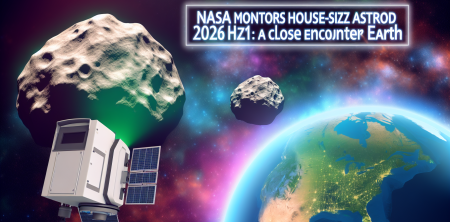
NASA is keeping a close watch on a small asteroid designated 2026 HZ1, which is set to make a close flyby of Earth on April 24, 2026. Measuring approximately 54 feet in diameter—about the size of a small house—this asteroid will approach our planet at a distance of 3.32 million miles. While this may sound like a considerable distance, in astronomical terms, it is relatively close, yet scientists assure us that there is no risk of impact.
The Significance of NASA’s Tracking Efforts
NASA's monitoring of near-Earth objects (NEOs) like asteroid 2026 HZ1 is a crucial aspect of planetary defense. These efforts aim to identify, track, and characterize objects that could pose a potential threat to Earth. With advances in technology, NASA has developed sophisticated systems to detect and follow the trajectories of these celestial bodies, ensuring that any potential dangers are assessed well in advance.
Understanding Asteroid 2026 HZ1
Asteroid 2026 HZ1 is classified as an Apollo-type asteroid, which means its orbit crosses that of Earth. Discovered relatively recently, its size is notable, as it falls within the category of small asteroids that can still cause significant damage if they were to enter the atmosphere undetected. However, due to its projected path, scientists have determined that there is no risk of collision with our planet during this upcoming flyby.
How Close is Close?
To put the distance of 3.32 million miles into perspective, consider that the average distance from the Earth to the Moon is about 238,855 miles. This means that asteroid 2026 HZ1 will pass by Earth at a distance that is more than twelve times the lunar distance. In the vastness of space, this distance is relatively safe, and astronomers have confirmed that the asteroid's trajectory will not bring it into contact with Earth.
Planetary Defense and the Importance of Tracking NEOs
The tracking of asteroids and comets is an essential part of ensuring the safety of our planet. NASA and other space agencies around the world are dedicated to monitoring these objects, particularly those classified as potentially hazardous. The ongoing efforts to catalog and track NEOs are vital for understanding the dynamics of these bodies and ensuring that we remain prepared for any future threats.
Technological Advancements in Detection
The detection of asteroids like 2026 HZ1 has been made possible through advancements in astronomical technology. Instruments such as telescopes equipped with advanced imaging capabilities allow astronomers to detect even small NEOs. The use of radar observations also enhances our understanding of an asteroid’s size, shape, and trajectory, enabling scientists to create accurate models of their paths.
Global Collaboration in Space Monitoring
NASA is not alone in its efforts; international collaboration plays a significant role in planetary defense. Organizations such as the European Space Agency (ESA) and other global space agencies work together to share data, resources, and research regarding NEOs. This cooperative approach enhances the global response capability to any potential asteroid threat.
What If an Asteroid Were to Strike Earth?
While asteroid 2026 HZ1 poses no threat, it raises questions about the potential consequences of an asteroid impact. Historical data informs us about past events, such as the Tunguska event in 1908, which caused significant destruction in Siberia. Understanding the implications of an impact helps in formulating response strategies.
Impact Scenarios and Preparedness
The effects of an asteroid impact depend on various factors, including the size, speed, and angle of entry. Smaller asteroids can disintegrate in the atmosphere, while larger ones may reach the surface, causing widespread devastation. Preparedness measures range from early warning systems to potential deflection strategies that could alter the trajectory of a threatening asteroid.
- Early Warning Systems: Monitoring systems are designed to detect potential threats well in advance, allowing time for mitigation strategies to be developed.
- Deflection Strategies: Various methods, such as kinetic impactors or gravitational tractors, are being researched to alter the path of an incoming asteroid.
- Public Awareness and Education: Raising awareness about the risks of asteroids helps communities understand the importance of preparedness.
The Future of Asteroid Tracking
The flyby of asteroid 2026 HZ1 serves as a reminder of the importance of continuous monitoring of near-Earth objects. As technology continues to evolve, so too will our capabilities to detect and respond to potential threats. The future of asteroid tracking looks promising, with plans for more advanced telescopes and observational platforms.
NASA’s Artemis Program and Asteroid Exploration
The Artemis program, which aims to return humans to the Moon and eventually send astronauts to Mars, also emphasizes the need for understanding asteroids. Missions under this program may include studies of asteroids to gather data that can be applied to planetary defense.
Conclusion: A Safe Flyby
As asteroid 2026 HZ1 approaches, the scientific community remains vigilant, ensuring that we are prepared for any potential risks posed by near-Earth objects. While the upcoming flyby on April 24, 2026, poses no danger to our planet, it underscores the ongoing commitment to planetary defense and the collaborative efforts needed to track these celestial wanderers.
In conclusion, the monitoring of asteroids like 2026 HZ1 is a testament to humanity's commitment to safeguarding our planet. With continued advancements in technology and cooperation among global space agencies, we can ensure a brighter, safer future in our cosmic neighborhood.

