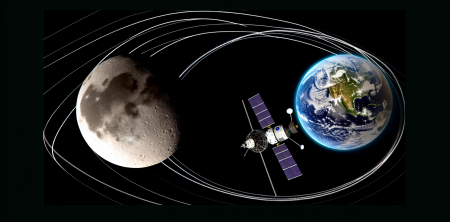
On April 1, 2026, NASA's Artemis II mission launched successfully, heralding a new era in humanity's quest to explore the Moon. This mission, which carries a crew of four astronauts—three from the United States and one from Canada—marks the first time since the Apollo 17 mission in 1972 that humans have ventured beyond low Earth orbit.
A Bold Return to the Moon
As the Artemis II mission took flight, it was not just a journey through space; it was a moment steeped in history and anticipation. The crew is made up of Commander Jeremy Hansen (Canada), Pilot Victor Glover, and Mission Specialists Christina Koch and Reed Wiseman. Their mission is to complete a lunar flyby, setting the stage for future lunar landings.
On April 6, 2026, the spacecraft achieved a significant milestone by conducting its lunar flyby. During this pivotal moment, the crew captured breathtaking images, including a remarkable view of the Moon eclipsing the Sun and an Earthset that echoes the iconic Earthrise photograph taken during the Apollo 8 mission.
The Technical Marvel of Artemis II
The Artemis II spacecraft, built atop NASA's powerful Space Launch System (SLS) rocket, serves as a platform for testing critical systems and technologies needed for future lunar exploration. The mission is designed not only to prepare the crew for Artemis III, scheduled for the following year, but also to gather invaluable data on the spacecraft's performance during the flyby.
During their nearly ten days in space, the crew successfully beamed back over 50 gigabytes of data to mission control. This data will be instrumental in refining systems and procedures for subsequent missions, paving the way for sustainable human presence on the Moon.
Scientific Significance of the Lunar Flyby
The scientific community is buzzing with excitement following the Artemis II flyby. Lunar scientists are eager to analyze the data collected during the mission, as it provides a wealth of information about the Moon's surface and environment. The flyby offers a unique opportunity to study the Moon's geology, composition, and potential resources.
Experts believe that the images and data collected will enhance our understanding of the Moon's history and its role in the solar system. The visual documentation, particularly the images of the lunar surface and the Earth from space, will be invaluable for educational and outreach efforts, inspiring future generations of scientists and explorers.
Looking Ahead: The Artemis III Mission
Following the success of Artemis II, focus now shifts to Artemis III, which is set to be an even more ambitious mission. Artemis III aims to land astronauts on the Moon's South Pole, a region believed to hold significant reserves of water ice and other resources. This mission is critical for establishing a sustainable lunar presence as part of NASA's broader vision for human exploration of Mars and beyond.
The Artemis program is not just about returning to the Moon; it signifies a new approach to space exploration, emphasizing international collaboration and partnerships. The inclusion of international astronauts and scientists, such as Canadian astronaut Jeremy Hansen, highlights the global interest in lunar exploration and the shared vision for humanity's future in space.
A New Era of Exploration
The Artemis program represents a transformative shift in how we view our relationship with the Moon and beyond. With advancements in technology and a renewed commitment to exploration, NASA is poised to lead the way in uncovering the mysteries of the Moon, while also preparing for future missions to Mars.
The successful flyby by the Artemis II crew not only marks a significant achievement in the timeline of space exploration but also serves as a reminder of the spirit of curiosity and discovery that drives humanity forward. As scientists continue to analyze the data and images from the mission, the excitement surrounding lunar exploration is expected to grow.
Conclusion: A Journey Just Beginning
The Artemis II mission is a testament to human ingenuity and the relentless pursuit of knowledge. As the crew prepares for their splashdown off the coast of San Diego, we are reminded that this is just the beginning of a new chapter in our exploration of the cosmos. With Artemis III on the horizon, the future looks bright for lunar exploration, and the possibilities are truly limitless.

