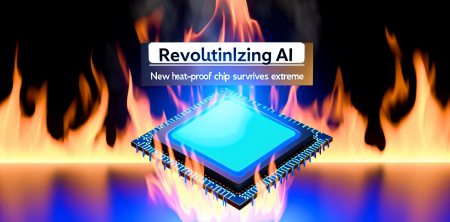
In a groundbreaking development, researchers at the University of Southampton have unveiled a new type of memory device capable of operating at extreme temperatures of up to 700°C (1300°F). This innovative chip, announced on April 7, 2026, promises to transform the landscape of artificial intelligence (AI) by enabling reliable data storage and processing in environments where traditional silicon-based chips fail.
The Need for Heat-Resistant Technology
The rapid advancement of AI technology has highlighted the limitations of current computing hardware, particularly in extreme conditions. Traditional chips are designed for standard operating temperatures and often struggle in environments that push the boundaries of thermal stability. As industries explore applications in space exploration, harsh industrial settings, and other extreme environments, the demand for robust, heat-resistant hardware has never been greater.
Potential Applications
The implications of this new heat-proof memory device are vast, especially for sectors that require advanced computing capabilities in challenging conditions. Some potential applications include:
- Space Exploration: Satellites and probes often encounter extreme temperatures in space, making it essential to have chips that can withstand these conditions without compromising performance.
- Industrial Settings: Manufacturing processes that involve high temperatures, such as metal forging or glass production, could benefit from chips that maintain functionality under intense heat.
- Advanced AI Systems: AI applications that require processing large datasets in real-time could leverage this technology to improve efficiency and reliability, particularly in dynamic environments.
How the Chip Works
The development of this heat-proof chip is a significant technological achievement. The research team at the University of Southampton utilized innovative materials and design techniques to create a memory device that could endure extreme temperatures while maintaining computational integrity.
The chip operates on principles that differ from conventional semiconductor technology, which typically degrades or fails at high temperatures. By incorporating new materials that can withstand thermal stress, the researchers have achieved a level of durability that could set a new standard in the industry.
Impacts on AI Computing
This breakthrough comes at a pivotal moment for AI, as the industry is continually seeking ways to enhance processing power and efficiency. With the ability to operate in extreme conditions, the new memory device could pave the way for:
- Enhanced Performance: AI systems could process information faster and more reliably, even in environments that were previously deemed unsuitable for computer operations.
- Increased Data Storage: The chip's durability could allow for greater data storage capacities, enabling more complex AI models and algorithms.
- New AI Applications: Industries may discover new applications for AI that were not feasible before due to hardware limitations, expanding the horizons of technology.
Challenges Ahead
Despite the excitement surrounding this technological advancement, there are challenges that researchers will need to address before widespread implementation can occur. One significant hurdle is the integration of this new chip into existing systems and infrastructures. As industries adopt this technology, compatibility with current hardware and software will be crucial.
Moreover, the cost of production and materials may pose barriers to entry for some sectors. Ensuring that this heat-proof chip can be produced at scale and at a reasonable cost will be essential for its adoption in commercial applications.
The Future of AI and Extreme Computing
The introduction of a heat-proof memory device marks a significant milestone in the evolution of AI technology. As the demand for more advanced, resilient, and efficient computing solutions grows, innovations like this chip will likely play a vital role in shaping the future of AI.
Researchers at the University of Southampton have set the stage for a new era of computing, where AI can thrive in environments once thought inhospitable. The potential for applications in space, industry, and beyond holds promise not only for technological advancement but also for scientific exploration and innovation.
As the world continues to embrace the possibilities of AI, this new chip could be the key to unlocking unprecedented capabilities in computing, further bridging the gap between human ingenuity and technological advancement.

