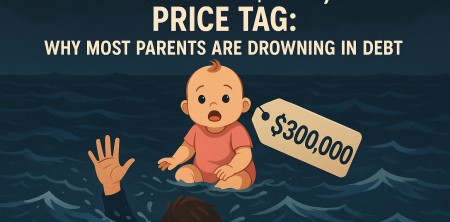
When you picture welcoming a new baby into your life, most parents envision tiny shoes, first steps, and endless cuddles. What few truly prepare for, however, is the eye-watering financial reality that awaits. Forget the nursery decor; we're talking about a staggering price tag that has now, for the first time ever, soared past the $300,000 mark. That's right – raising a child from birth to age 18 in the United States will now set you back an average of $300,000, and that figure doesn't even include college tuition. This isn't just a number; it's a seismic shift, creating what many are calling "parenting inflation" and pushing families to their financial limits, often into debt, and even influencing their family planning decisions.
Recent reports, including a comprehensive analysis from LendingTree and SmartAsset, paint a stark picture. They reveal that the average annual cost of raising a child now stands at $16,857. This isn't theoretical; it's the lived experience of millions of parents grappling with rising expenses across every category imaginable. From the moment that positive pregnancy test appears, a countdown begins, not just to a due date, but to a lifetime of significant financial commitments. Understanding the true cost of raising a child is no longer just a budgeting exercise; it's a critical component of family planning and economic survival.
The Staggering $300,000 Milestone: A New Financial Reality
For decades, economists and family researchers have tracked the expenses associated with raising children. But the $300,000 threshold, now officially breached, represents a monumental shift. This isn't a gradual creep; it's a substantial leap that has taken many parents by surprise. When we talk about this figure, it’s crucial to remember what it encompasses: the daily, weekly, and yearly expenditures that accumulate over 18 years. We're looking at everything from diapers and formula in infancy to school supplies, clothing, healthcare, and food as they grow. It's the relentless drumbeat of expenses that never truly stops until a child reaches adulthood, and even then, often continues in various forms.
This isn't just about inflation affecting groceries or gas; it's a specific, concentrated pressure on families. The LendingTree study, which factored in data up to 2026 to project current trends, highlighted that this average annual cost of $16,857 is a national figure. However, it fluctuates dramatically depending on where you live. Some states are experiencing year-over-year increases of over 20%, far outpacing general inflation rates. This creates a postcode lottery for parents, where the same essential goods and services can vary wildly in price, directly impacting the overall cost of raising a child in a particular region.
The implications of this $300,000 benchmark are profound. For many prospective parents, it can be a deterrent, prompting serious reconsideration of family size or even the decision to have children at all. For those already in the thick of it, it means constant financial juggling, sacrifices, and often, tapping into savings or accumulating debt just to keep pace. It redefines what it means to be a financially stable parent in modern America, pushing the boundaries of affordability for the middle class and beyond.
"Parenting Inflation" and Its Relentless Drivers
Why are costs skyrocketing at such an alarming rate? Experts have coined the term "parenting inflation" to describe this phenomenon, and it's driven by a perfect storm of economic pressures. It's not one single factor, but a confluence of rising expenses across several critical categories that directly impact families with children. Understanding these drivers is key to grasping the full scope of the financial challenge.
One of the most significant contributors, and arguably the most talked-about, is childcare. The cost of sending a child to daycare or preschool has become astronomical in many parts of the country, often rivaling or even exceeding college tuition in some areas. But it's not just childcare. Food prices have seen substantial increases, impacting grocery bills for growing families. Housing costs, whether rent or mortgage payments, continue their upward trajectory, and families with children often need more space, exacerbating this issue. Then there are healthcare costs, which seem to climb relentlessly, and the ever-present desire to provide enriching experiences through extracurricular activities – sports, music lessons, tutoring – all of which add up.
These aren't luxuries; they are, for the most part, essential components of a child's upbringing in today's society. The pressure to provide these elements, coupled with their escalating prices, creates immense strain. This compounding effect means that families aren't just facing higher costs in one area; they're seeing their budgets squeezed from every direction, making the overall cost of raising a child an increasingly daunting prospect. (See: positive parenting resources.)
The Childcare Crisis: A National Emergency
If there's one area that encapsulates the crisis of parenting inflation, it's childcare. This isn't merely an expense; it's a foundational pillar that supports parents' ability to work and children's early development. Yet, it's an industry in dire straits, with repercussions echoing through individual households and the broader economy alike. The cost of quality childcare has become prohibitive for many families, forcing difficult choices and creating a ripple effect of instability.
Many childcare programs are struggling to stay afloat. They face their own rising operational costs – rent, utilities, insurance, and most critically, the need to pay competitive wages to attract and retain qualified staff. However, because parents are already stretched to their limits, providers often can't raise fees enough to cover these expenses without losing families. This Catch-22 leads to programs closing or operating with thin margins, creating a scarcity of affordable, high-quality options. When families can't find or afford childcare, parents (disproportionately mothers) are often forced to reduce their work hours, take lower-paying jobs with more flexibility, or leave the workforce entirely. This loss of income further compounds the financial strain of the cost of raising a child. There's a fuller look at the shocking cost breakdown.
The impact extends beyond individual families. The childcare crisis destabilizes the labor market, hinders economic growth, and exacerbates gender inequality. It's a systemic issue that demands comprehensive solutions, not just individual budgeting hacks. Without accessible and affordable childcare, the aspirations of many parents, and the potential of many children, are held back.
The Debt Trap: How Parents Are Coping (or Not)
The grim reality of the rising cost of raising a child is that many families simply cannot absorb these expenses without making significant financial sacrifices. A LendingTree survey highlighted this stark truth: a staggering 82% of parents acknowledge that raising children is more expensive than they anticipated. Even more concerning, 64% admit they've incurred debt to cover these costs. This isn't discretionary spending debt; it's often debt for necessities.
Imagine needing to put groceries on a credit card, taking out personal loans for unexpected medical bills, or accumulating balances to pay for school uniforms or essential extracurriculars. This kind of debt isn't just a number; it's a heavy burden that can impact a family's financial health for years, if not decades. High-interest credit card debt can quickly spiral, making it even harder to escape the cycle. This debt also eats into other critical financial goals, like saving for a down payment on a home, building an emergency fund, or planning for retirement – all of which are essential for long-term family security.
The emotional toll of this financial strain is also immense. Constant worry about money can lead to stress, anxiety, and conflict within households. It forces parents to make excruciating choices, sometimes sacrificing their own well-being or career aspirations in an attempt to make ends meet. This isn't just about financial numbers; it's about the quality of life and the mental load carried by parents striving to provide for their children in an increasingly expensive world.
Family Planning Decisions Under Financial Duress
Perhaps one of the most profound and often unspoken consequences of the escalating cost of raising a child is its direct impact on family planning. The LendingTree survey revealed a telling statistic: 44% of parents have opted to have fewer children than they originally intended, purely due to financial constraints. This isn't a lifestyle choice; it's a forced concession, a painful adjustment of dreams and aspirations in the face of economic reality.
For many couples, the decision to have children, and how many, is deeply personal and often tied to cultural, emotional, and even spiritual beliefs. To have those decisions dictated by financial pressures is a heartbreaking reality. It means that families who might have envisioned a larger household are now consciously choosing to stop at one or two children, or perhaps deferring having children altogether, because the numbers simply don't add up. They weigh the joy of a larger family against the crushing weight of debt, the sacrifice of career progression, or the inability to provide adequately for the children they already have. (See: impact of parenting inflation.)
This trend has broader demographic implications, potentially contributing to lower birth rates in developed countries. It highlights a fundamental disconnect between societal expectations and economic realities. We celebrate families and children, but the systems in place often fail to adequately support them, leaving individuals to bear an increasingly heavy financial load when it comes to the true cost of raising a child. (family planning tips)
Geographic Disparities: Where Does Your State Stand?
While the $300,000 figure is a national average, it masks significant regional variations. The cost of raising a child is not uniform across the United States; it's a patchwork of expenses that can make living in one state dramatically different from another. These geographic disparities are primarily driven by differences in housing costs, childcare expenses, and local taxation, creating a complex financial landscape for families.
For instance, states with high costs of living, like Massachusetts, Hawaii, or parts of California and New York, will see the average cost of raising a child soar far beyond the national average. In these regions, housing alone can consume a disproportionate share of a family's income, leaving less for other essential child-related expenses. Childcare in major metropolitan areas can easily exceed $20,000-$30,000 per year per child, making it an insurmountable barrier for many.
Conversely, states with a lower cost of living, typically in the Midwest or South, may offer some financial reprieve. While no state is truly "cheap" for raising children anymore, the total lifetime cost can be tens of thousands, or even hundreds of thousands, less than in the most expensive areas. This discrepancy can influence where families choose to live, or whether they can afford to stay in their home state, particularly for those with careers that offer geographic flexibility. Understanding these state-by-state comparisons is crucial for families considering relocation or simply trying to budget more effectively within their current locale.
Beyond the Essentials: The Hidden Costs and Future Investments
The $300,000 figure, while daunting, primarily covers the essentials: food, housing, clothing, healthcare, and basic childcare. But any parent knows that raising a child involves so much more. There are the "hidden costs" that often sneak up on budgets, and then there are the crucial "future investments" that, while technically excluded from the 18-year calculation, are absolutely vital for a child's long-term success.
Hidden costs can include everything from birthday parties and holiday gifts to school field trips, sports equipment, musical instruments, and technology (laptops, phones). What about braces, tutoring, or therapy if a child needs it? These aren't always considered "basic" but become essential components of a well-rounded childhood and can add thousands of dollars annually. Furthermore, as children become teenagers, their appetites grow, their clothing needs change, and their social lives often involve more expenses. The desire to keep up with peers or to provide enriching experiences can put additional, often unexpected, pressure on family finances.
Then there's the elephant in the room: college. While the $300,000 figure stops at age 18, most parents aspire to send their children to higher education. The average cost of a four-year degree can easily add another $100,000 to $200,000, or significantly more for private institutions, pushing the total lifetime cost of raising a child well into the half-million-dollar range. This necessitates dedicated college savings, like 529 plans, which represent another significant financial commitment on top of daily expenses. Ignoring these future investments would be short-sighted, as they are integral to a child's future prospects.
Strategies for Navigating the Financial Maze
Given these staggering numbers, it's easy for parents to feel overwhelmed, but there are proactive steps families can take to better manage the financial maze of raising children. It requires a combination of meticulous budgeting, strategic planning, and a willingness to explore all available resources.
- Rigorous Budgeting: Start by tracking every dollar. Use budgeting apps or spreadsheets to identify where your money is going. This clarity is the first step toward finding areas to optimize. Differentiate between needs and wants, and be prepared to make tough choices.
- Emergency Fund: Before tackling other savings goals, build a robust emergency fund. Three to six months of living expenses can provide a crucial buffer against unexpected medical bills, job loss, or other unforeseen costs that often arise with children.
- Smart Childcare Choices: Research all childcare options. This might include in-home care, co-op programs, or exploring state subsidies if eligible. Consider if one parent reducing hours or working remotely could offset childcare costs, though be mindful of the long-term career impact.
- Leveraging Tax Credits and Benefits: Don't leave money on the table. Familiarize yourself with federal and state tax credits for families and children, such as the Child Tax Credit, Child and Dependent Care Credit, and Earned Income Tax Credit.
- Bulk Buying and Meal Planning: For essentials like food and diapers, buying in bulk when sales hit can lead to significant savings. Meal planning reduces waste and impulse purchases, directly impacting the grocery budget.
- Second-Hand and Hand-Me-Downs: Children grow quickly! Embrace second-hand clothing, toys, and gear from consignment stores, online marketplaces, or friends and family. This can save thousands over 18 years.
- College Savings (529 Plans): Even small, consistent contributions to a 529 plan can grow significantly over time thanks to compound interest. Start early, even with modest amounts, to soften the blow of future college expenses.
- Financial Literacy for Children: As they grow, involve children in age-appropriate discussions about money. Teach them about saving, spending, and the value of goods and services. This prepares them for their own financial independence and can help them understand family budgeting.
While these strategies won't eliminate the high cost of raising a child, they can certainly make it more manageable and help families avoid the pitfalls of debt.
Looking Ahead: Policy Changes and Societal Support
The individual burden of the $300,000 price tag is immense, but it also underscores a societal challenge that demands broader policy solutions. Relying solely on individual families to absorb these escalating costs is proving unsustainable, leading to demographic shifts and economic instability. What role should government and society play in alleviating this pressure?
One critical area is childcare reform. Investing in universal preschool, subsidizing childcare costs, or offering tax incentives for providers could make a significant difference. Policies that support paid family leave would also allow parents to spend crucial early months with their infants without sacrificing income or job security. Expanding the Child Tax Credit, making it fully refundable, or increasing the benefit amount could provide direct financial relief to millions of families, helping to offset the core expenses of food, housing, and clothing. the harsh truth about parenting offers useful background here.
Beyond direct financial aid, there's a need for community support systems. Accessible and affordable after-school programs, subsidized youth sports, and public health initiatives can all contribute to reducing the out-of-pocket expenses for parents. Addressing the broader issues of affordable housing and rising healthcare costs also directly impacts the overall cost of raising a child. Ultimately, a thriving society depends on well-supported families, and acknowledging the true financial strain on parents is the first step toward building more robust support structures.
The reality of raising a child in America today is complex, expensive, and often overwhelming. The $300,000 benchmark is not just a statistic; it's a call to action for families, policymakers, and communities to confront the escalating costs and find innovative ways to ensure that the joy of parenthood isn't overshadowed by insurmountable financial burdens. As parents, we want the best for our children, and that often means navigating a financial landscape that is more challenging than ever before.
Trending Now
Frequently Asked Questions
How much does it cost to raise a child in the US?
Raising a child in the United States now costs an average of $300,000 from birth to age 18. This figure encompasses essential expenses such as food, healthcare, clothing, and education, excluding college tuition.
What factors contribute to the high cost of raising a child?
The high cost of raising a child is influenced by various factors including increased prices for childcare, healthcare, food, clothing, and education. These rising expenses create a significant financial burden for many families.
What is parenting inflation?
Parenting inflation refers to the rising costs associated with raising children, which have significantly increased over the years. This phenomenon places financial strain on families, often leading to debt and impacting family planning decisions.
What are the average annual costs of raising a child?
The average annual cost of raising a child is approximately $16,857. This amount reflects ongoing expenses such as food, clothing, healthcare, and education, which accumulate over the years.
How can parents prepare for the financial responsibilities of raising a child?
Parents can prepare for the financial responsibilities of raising a child by creating a detailed budget, researching costs, and planning for both immediate expenses and future needs. Understanding the full scope of child-rearing costs is essential for effective family planning.
Agree or disagree? Drop a comment and tell us what you think.

