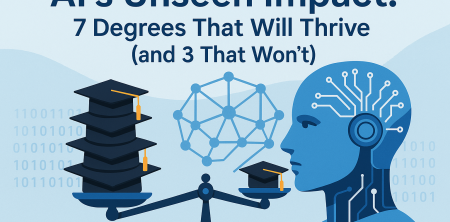
Alright, let's talk about the elephant in the room: AI. It's not just a buzzword anymore; it's a force reshaping our economy, our workplaces, and, critically, the value of a college degree. For years, we've pushed our kids towards STEM, towards the supposed 'future-proof' fields of computer science and engineering, believing these were the surest paths to success. But what if I told you that, according to recent data, some of those very fields are now among the most vulnerable to automation?
It’s a tough pill to swallow, isn't it? A September 2026 US Census Bureau working paper, highlighted in a Business Insider article, paints a rather stark picture. Graduates from what we once considered 'high-exposure' fields – think computer science and various engineering disciplines – are reportedly 5 percentage points less likely to be employed and are facing 13% lower initial earnings after the widespread availability of tools like ChatGPT. This isn't just about jobs disappearing; it's about the entire calculus of educational investment changing. So, if you're a student weighing your options, or a parent trying to guide your child, you've got to ask: what are the best degrees for job security 2026 and beyond?
The good news? Not all degrees are created equal in the face of this AI revolution. In fact, some sectors are proving remarkably resilient, even thriving. It turns out that the human touch, complex problem-solving, and fields requiring deep empathy and nuanced understanding are precisely where AI struggles to compete. Let's dig into the degrees that are set to offer genuine job security in the coming years, and why they’re a smart bet for your future.
1. Nursing and Healthcare Administration: The Unshakeable Human Element
When you talk about jobs that are 'AI-proof,' healthcare is almost always at the top of the list, and for good reason. Think about it: could you ever truly replace a compassionate nurse with an algorithm? While AI can certainly assist in diagnostics, data analysis, and even robotic surgery, the core of healthcare delivery remains deeply human. Nurses provide hands-on care, emotional support, critical thinking in dynamic situations, and complex communication that AI simply can't replicate. They're at the bedside, interacting with patients and families, making split-second decisions that require judgment, empathy, and a deep understanding of human suffering and hope.
Beyond direct patient care, consider Healthcare Administration. This field is about managing the intricate systems that keep hospitals, clinics, and public health initiatives running smoothly. It involves navigating complex regulations, managing budgets, optimizing patient flow, and leading teams of diverse professionals. While AI can undoubtedly help with data analytics and operational efficiencies, the strategic planning, ethical decision-making, interpersonal negotiation, and leadership required to run a healthcare organization are inherently human tasks. These roles demand a blend of business acumen and a profound understanding of healthcare's unique challenges and societal impact, making them some of the best degrees for job security 2026.
2. Education (K-12 and Higher Education): The Irreplaceable Mentor
As a former K-12 teacher and Dean of Education, I can tell you firsthand: nothing replaces a good teacher. Education, from kindergarten classrooms to university lecture halls, is another sector proving incredibly resilient to AI's encroachment. While AI can certainly personalize learning, grade papers, and provide vast amounts of information, it utterly fails to replicate the nuanced, dynamic, and deeply personal process of teaching and mentorship.
Effective teaching involves more than just delivering facts; it's about inspiring curiosity, fostering critical thinking, developing social-emotional skills, and adapting to the unique needs of every single student. It requires empathy, patience, creative problem-solving, classroom management, and the ability to build meaningful relationships. These are inherently human qualities. Furthermore, the role of educators extends beyond the classroom to curriculum development, educational policy, and leadership roles within school systems. These positions demand strategic thinking, collaboration, and a deep understanding of pedagogical principles that AI simply cannot provide. The best degrees for job security 2026 definitely include those preparing you for a career in education.
3. Counseling and Social Work: The Art of Human Connection
In a world that often feels increasingly isolated and complex, the need for human connection and support is only growing. This is where fields like counseling and social work shine. These professions are built entirely on human interaction, empathy, active listening, and the ability to navigate complex emotional and social landscapes. Can an AI chatbot offer therapy? Perhaps at a superficial level, but it can never truly understand the depth of human experience, the nuances of trauma, or the complexities of family dynamics in the way a trained human professional can. (See: US Census Bureau working paper.)
Social workers, for instance, often work with vulnerable populations, connecting individuals and families with resources, advocating for their rights, and providing crucial support during crises. This work requires profound cultural competence, ethical judgment, and the ability to build trust – qualities that are fundamentally human. Similarly, counselors, whether in schools, private practice, or community settings, help individuals process emotions, develop coping strategies, and navigate life's challenges. These roles demand a level of emotional intelligence and interpersonal skill that is far beyond the capabilities of current or foreseeable AI, making them highly secure career paths.
4. Trades and Skilled Labor: Hands-On and Essential
It's easy to get caught up in the digital revolution and forget about the foundational skills that keep our world running. The skilled trades – electricians, plumbers, HVAC technicians, carpenters, welders, and mechanics – are absolutely essential, and they require a hands-on dexterity, problem-solving ability, and adaptability that AI and robots struggle to fully replicate. While robots can certainly assist in manufacturing or perform repetitive tasks, they can't diagnose a complex electrical fault in an old building, creatively snake a pipe through a challenging space, or troubleshoot a finicky HVAC system in a residential home. For more context, see AI chatbot protections and risks to kids.
These professions demand critical thinking, spatial reasoning, and the ability to work in unpredictable environments. Every job site, every repair, presents a unique set of challenges that requires human ingenuity and adaptability. Plus, many of these roles involve direct client interaction, requiring communication skills and a customer service orientation. The demand for these skilled professionals remains consistently high, and these jobs offer excellent remuneration without necessarily requiring a four-year university degree, though specialized training and certifications are crucial. When considering the best degrees for job security 2026, don't overlook the vital role of trade schools and vocational programs.
5. Creative Arts and Design (Certain Specializations): The Spark of Originality
Now, this one might seem counterintuitive, especially with the rise of AI art generators. However, it's crucial to distinguish between AI-generated content and truly original, human-driven creativity. While AI can mimic styles and produce aesthetically pleasing images or text, it lacks genuine understanding, personal experience, and the ability to inject profound meaning, emotion, or cultural commentary into its work. The truly innovative, boundary-pushing aspects of art and design still firmly reside in the human domain.
Consider roles in concept art, high-level graphic design, fashion design, game design, or even strategic marketing where the core task is to create compelling narratives and innovative solutions that resonate deeply with human audiences. These fields require intuition, cultural sensitivity, emotional intelligence, and the ability to synthesize complex ideas into unique, impactful forms. While AI can be a tool, the *visionary* and *curatorial* aspects of creative work, the ability to tell a story that truly moves people, remains a human prerogative. Degrees in these specialized creative areas, especially those emphasizing critical thinking and unique voice, offer promising avenues for job security.
6. Legal Professions (Specialized Areas): The Nuance of Justice
The legal field is one where AI's impact is already being felt, particularly in areas like document review and legal research. However, this doesn't mean the entire profession is at risk. Far from it. What AI struggles with, and what will remain the bedrock of legal work, is the nuanced interpretation of complex laws, the strategic thinking required in litigation, the art of negotiation, and the deeply human element of advocating for clients in court. Imagine trying to explain the subtleties of a constitutional argument or the emotional impact of a case to an AI – it simply can't grasp the human implications.
Specialized legal areas, particularly those involving direct client interaction, complex ethical dilemmas, or highly personalized advice, are likely to remain secure. Think family law, criminal defense, intellectual property litigation, or human rights law. These roles require empathy, persuasive communication, and a profound understanding of justice and human behavior. While AI can streamline administrative tasks, the core intellectual and interpersonal demands of being a lawyer are distinctly human. Pursuing specialized legal certificates or focusing on these less automatable areas can significantly boost job security for legal professionals.
7. Psychology and Cognitive Science (Research and Applied): Understanding the Human Mind
The study of the human mind and behavior is, by its very nature, profoundly human. While AI can analyze vast datasets of human behavior or even simulate certain cognitive processes, it cannot truly *understand* consciousness, emotion, motivation, or the complexities of mental health in the way a human psychologist or cognitive scientist can. These fields are about unraveling the mysteries of what makes us human, and that requires human insight, empathy, and qualitative understanding.
Degrees in psychology and cognitive science can lead to diverse roles, from research into human decision-making and perception to applied fields like user experience (UX) research, where understanding human interaction with technology is paramount. Clinical psychology, as mentioned under counseling, is also highly secure. Even in areas like AI development, professionals with a deep understanding of human cognition are increasingly valuable for designing ethical, user-friendly, and truly intelligent AI systems. Their insights ensure that AI serves human needs, rather than merely mimicking them. This blend of scientific rigor and human understanding makes these some of the best degrees for job security 2026.
The Unexpected Vulnerability: What About Computer Science and Engineering?
This is where the conversation gets controversial, and frankly, a little uncomfortable for many. For decades, computer science and engineering degrees have been held up as the gold standard for career prospects. And in many ways, they still are. However, the September 2026 US Census Bureau working paper, as highlighted by Business Insider, throws a significant wrench into that long-held assumption when it comes to *initial* job security in an AI-saturated market. (See: New York Times article on AI job market.)
The core issue isn't that these fields are obsolete; it's that certain aspects of them are highly susceptible to automation. Routine coding, debugging, data entry, and even some levels of algorithm design can now be performed or significantly augmented by AI. This means that entry-level positions, or roles focused on more repetitive technical tasks, are becoming increasingly competitive and potentially less lucrative. Graduates in these 'high-exposure' fields were 5 percentage points less likely to be employed and faced 13% lower initial earnings after ChatGPT became widely available. That's a serious dip, and it forces us to re-evaluate what we tell our aspiring tech gurus. For more context, see Oregon's education system and literacy ranking.
Does this mean you should avoid these degrees entirely? Absolutely not. But it does mean that the *type* of computer science or engineering degree, and the *skills* you cultivate within it, matter more than ever. The demand will shift towards highly specialized roles: AI ethics, advanced machine learning research, complex system architecture, cybersecurity, and roles that require profound creativity, critical thinking, and interdisciplinary knowledge – areas where human ingenuity is still paramount. It's about specializing, innovating, and focusing on the problems AI can't solve on its own.
Rethinking 'Future-Proof': It's About Adaptability, Not Immunity
The concept of a 'future-proof' degree is, honestly, a bit of a misnomer. In a rapidly evolving world, true security comes not from immunity to change, but from adaptability. The degrees I've highlighted above are strong contenders for the best degrees for job security 2026 because they lean into uniquely human strengths: empathy, complex communication, critical judgment, creativity, and hands-on problem-solving in unpredictable environments. These are the qualities that AI, at its current and foreseeable stages, struggles to replicate.
However, even in these fields, continuous learning and adaptation are crucial. A nurse who can leverage AI tools for better patient outcomes will be more valuable than one who can't. An educator who understands how to integrate personalized AI learning platforms will be more effective. The goal isn't to run from technology, but to master the skills that complement it, making you an indispensable part of any team. It's about being the human at the helm, guiding and leveraging the tools, rather than being replaced by them.
The Evolving Role of Soft Skills
While we often focus on technical proficiencies, the AI revolution is undeniably elevating the importance of what we call "soft skills." These aren't just buzzwords; they're the bedrock of human interaction and problem-solving that AI simply can't replicate. Think about it: a machine can process data faster than any human, but can it mediate a conflict between team members? Can it inspire a struggling student, or provide comfort to a grieving family? Absolutely not. That's where human beings, armed with strong soft skills, become irreplaceable.
Degrees that inherently foster these skills – communication, critical thinking, collaboration, creativity, emotional intelligence, and adaptability – are becoming increasingly valuable. These aren't necessarily taught in a single course, but are woven into the fabric of humanities, social sciences, and even the hands-on problem-solving demanded by the trades. For example, a liberal arts education, often criticized for its lack of direct career paths, actually excels at cultivating many of these crucial soft skills. When combined with practical knowledge or a specialized focus, these foundational human abilities make you incredibly resilient in a changing job market. It's not just about what you know, but how you interact, think, and solve problems in a distinctly human way that will define the best degrees for job security 2026.
The Interdisciplinary Advantage
Another key strategy for securing your future in an AI-driven world is pursuing an interdisciplinary education. The days of siloed academic fields are becoming less relevant. Complex global challenges and technological advancements require solutions that draw from multiple disciplines. For instance, someone with a background in both computer science and psychology might be uniquely positioned to design ethical AI systems that truly understand human behavior. An engineer with a strong foundation in environmental policy can develop sustainable infrastructure solutions. A healthcare administrator who understands both business and public health can navigate complex policy landscapes more effectively. For more context, see how insurance careers will thrive by 2026. (See: BBC report on AI and employment.)
Seeking out programs that encourage minors, double majors, or specialized concentrations that bridge different fields can significantly enhance your marketability. This approach not only broadens your knowledge base but also hones your ability to connect disparate ideas, think holistically, and communicate across different professional languages. This kind of nuanced understanding and ability to synthesize information from various perspectives is something AI struggles with, making interdisciplinary thinkers highly sought after. When you're looking for the best degrees for job security 2026, consider how you can combine seemingly unrelated fields to create a truly unique and valuable skill set.
Real-World Experience: The Unsung Hero
No matter what degree path you choose, real-world experience is becoming increasingly critical. Internships, co-op programs, volunteer work, and part-time jobs in your chosen field aren't just resume builders; they're essential learning opportunities. They allow you to apply theoretical knowledge in practical settings, develop professional networks, and most importantly, gain insights into the actual demands and nuances of a profession. This hands-on experience helps you understand which aspects of a job are automatable and which require human ingenuity.
For example, a nursing student who completes multiple clinical rotations gains invaluable experience in patient interaction, critical decision-making under pressure, and teamwork – skills that are inherently human. A student in a skilled trade program who apprentices with a master craftsman learns not just techniques, but the art of problem-solving and client communication. This practical exposure helps you refine your skills, adapt to real-world challenges, and demonstrate to potential employers that you can navigate the complexities of a job beyond what a textbook teaches. In the race for the best degrees for job security 2026, combining academic rigor with meaningful practical experience is a winning formula.
Making Informed Decisions for Your Educational Investment
So, what does this mean for you, or for the young people in your life who are currently grappling with college choices? It means thinking critically, looking beyond traditional advice, and understanding the nuances of the evolving job market. Don't just pick a major because it sounds prestigious or because 'everyone says it's good.' Dig into the actual tasks involved in those professions. Ask yourself: could a sophisticated AI perform this core function with relative ease? If the answer is yes, then you need to think about how you can differentiate yourself, perhaps through specialization, interdisciplinary study, or by focusing on the 'human' aspects of that field.
Consider:
- The Human-Centric Fields: Prioritize degrees that require deep empathy, complex interpersonal communication, ethical judgment, and hands-on problem-solving.
- Specialization within Tech: If tech is your passion, focus on cutting-edge, human-centric areas like AI ethics, human-computer interaction, or cybersecurity, where critical thinking and unique problem-solving are paramount.
- Lifelong Learning: Regardless of your major, commit to continuous skill development. The ability to learn new tools and adapt to new technologies will be your greatest asset.
- Vocational Training: Don't underestimate the power and stability of skilled trades. These are often high-paying, in-demand jobs that are fundamentally hands-on.
- Cultivating Soft Skills: Actively seek opportunities, both in and out of the classroom, to develop your communication, collaboration, creativity, and emotional intelligence.
- Interdisciplinary Studies: Explore combining majors or minors from different fields to create a unique and highly adaptable skill set.
- Gain Real-World Experience: Actively pursue internships, co-ops, and other practical experiences to bridge the gap between academic learning and professional practice.
The educational landscape is shifting, and with it, our understanding of what constitutes a 'safe' career path. The insights from the US Census Bureau working paper and Business Insider are a wake-up call, urging us to reconsider where true value and job security lie in an AI-driven future. It's an exciting, albeit challenging, time to be making these decisions, and choosing one of the best degrees for job security 2026 means looking at the bigger picture and investing in skills that stand the test of time and technology.
Trending Now
Frequently Asked Questions
What degrees will thrive in the age of AI?
Degrees in healthcare, psychology, education, and social work are expected to thrive as they require human empathy and complex problem-solving skills that AI struggles to replicate. Fields like nursing and healthcare administration are particularly resilient, providing strong job security as the demand for human-centered roles continues to grow.
Which degrees are becoming less valuable due to AI?
Degrees in high-exposure fields such as computer science and engineering are becoming less valuable due to AI advancements. Recent studies indicate that graduates in these areas are facing lower employment rates and reduced earnings, as automation tools like ChatGPT change the job landscape significantly.
How is AI affecting job security for college graduates?
AI is reshaping job security by automating tasks traditionally performed by graduates in certain fields. Graduates in high-tech sectors may find themselves with fewer job opportunities and lower initial earnings, prompting a reevaluation of degree choices for long-term career prospects.
What should students consider when choosing a degree in 2026?
Students should consider the resilience of their chosen field against AI automation. Degrees that emphasize human interaction, creativity, and complex decision-making, such as those in healthcare, social sciences, and education, are likely to offer better job security and opportunities in the evolving job market.
Why are healthcare degrees considered AI-proof?
Healthcare degrees are considered AI-proof due to the essential human elements involved in patient care, such as empathy, compassion, and interpersonal skills. While AI can assist in diagnostics and administration, the human touch remains irreplaceable in providing effective healthcare and support.
Agree or disagree? Drop a comment and tell us what you think.

