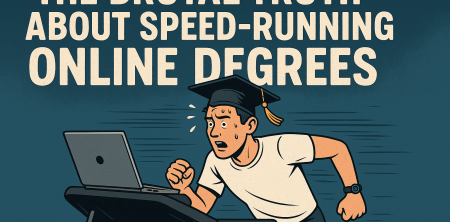
Imagine earning a bachelor's or even a master's degree in a matter of weeks, not years. Sounds too good to be true, right? Well, for a growing number of students, this isn't a fantasy—it's a controversial reality. A new trend has emerged where individuals are "speed-running" online degrees, leveraging the flexible structures of certain institutions to complete entire programs at breakneck speed. This phenomenon of online degree acceleration is sparking heated debates across the education landscape, leaving many educators and institutions deeply concerned about academic integrity and the perceived value of these rapid-fire credentials.
One anecdote making the rounds tells of someone who reportedly bagged two degrees in just eight weeks, all for a little over $4,000. Now, this individual is apparently coaching others on how to replicate this incredibly accelerated path. It's a testament to how attractive the promise of significant time and cost savings can be. But what does it truly mean for the future of higher education, and more importantly, for the students themselves? As someone who’s spent years in the K-12 and P-20 education space, from teaching in classrooms to serving as a Dean, I can tell you this isn't just a minor blip; it's a seismic shift that demands our attention and careful consideration.
1. The Allure of Accelerated Online Degree Programs: Time and Cost Savings
Let's be honest, the traditional four-year degree path can feel like a marathon, both financially and academically. Tuition fees continue to climb, and the idea of spending years in classrooms, even virtual ones, can be daunting for adults juggling work, family, and other commitments. This is where the appeal of online degree acceleration truly shines. The prospect of shaving years off your educational journey and saving tens of thousands of dollars is incredibly enticing.
For many, this isn't just about convenience; it's about opportunity. A quicker degree means faster entry into a new career, quicker promotions, or the ability to meet credentialing requirements without putting life on hold. Imagine being able to jump into a higher-paying job months or even years sooner than your peers who chose the traditional route. It’s a powerful motivator, especially in a competitive job market where every edge counts. This promise of efficiency is a major draw for non-traditional students, working professionals, and anyone looking to upskill or reskill without incurring massive debt or extended time away from the workforce.
Beyond the immediate financial and time benefits, there's also the psychological advantage. The feeling of accomplishment that comes with rapid progress can be incredibly motivating. For individuals who might have paused their education due to life circumstances, or those who feel stuck in their current career path, the idea of a fast-track degree offers a renewed sense of possibility. It's not just about getting the piece of paper; it's about reclaiming agency over their educational and professional lives. This accelerated path democratizes access to higher education for those who simply cannot commit to the traditional model, providing a much-needed alternative in a diverse learning landscape.
2. How "Speed-Running" Works: Leveraging Self-Paced Models
So, how exactly are students pulling off this online degree acceleration? It largely comes down to the design of specific online programs, particularly those offering unlimited self-paced courses. Unlike traditional semester-based programs with fixed deadlines, these models allow students to move through material as quickly as they can master it. If you already possess knowledge in a subject area, perhaps from prior work experience or self-study, you can often test out of modules or complete assignments at an accelerated pace.
Some institutions operate on a subscription model or offer competency-based education where you pay for a set period, say six months, and can complete as many courses as you can during that time. For a highly motivated and disciplined individual, or someone with significant prior learning, this can mean completing multiple courses in a fraction of the time it would take in a traditional setting. This flexibility, while intended to accommodate diverse learning styles and schedules, has inadvertently opened the door to extreme acceleration, pushing the boundaries of what was previously thought possible for degree completion.
A key aspect of these self-paced models is the reliance on prior learning assessment (PLA). Many adult learners come to higher education with a wealth of knowledge gained through work, military service, or informal learning. PLA allows these students to demonstrate what they already know and receive academic credit for it, bypassing the need to retake courses covering familiar material. This isn't just about speed; it's about respecting and validating a student's existing intellectual capital. Combine PLA with a truly self-paced, competency-based curriculum, and you have the perfect storm for online degree acceleration. Students can focus their efforts only on the areas where they lack mastery, making their educational journey incredibly efficient. This approach shifts the focus from "time spent" to "knowledge acquired," which for many, is a more authentic measure of learning.
3. The Purdue Global Response: Implementing Restrictions
The rise of extreme online degree acceleration hasn't gone unnoticed by institutions themselves. Purdue Global, a prominent online arm of Purdue University, has reportedly begun implementing restrictions in response to these speed-running tactics. Their concerns are quite explicit: they cite issues with "academic integrity and the value of a Purdue Global degree." This is a significant move from a major player in the online education space.
When a respected institution like Purdue Global starts putting the brakes on, it signals that the phenomenon has reached a point where it's challenging the very foundation of their educational offerings. Their reputation, and by extension, the value of the degrees they award, is paramount. If degrees can be acquired with what appears to be minimal effort or time, it inevitably devalues the credentials for all graduates, including those who pursued their education through more traditional means. It raises questions about the rigor and depth of learning that can genuinely occur in such compressed timelines.
Purdue Global's actions highlight a critical tension: the desire to offer flexible, accessible education versus the imperative to maintain academic standards and institutional reputation. For an institution that carries the Purdue name, the potential for its degrees to be perceived as "easy" or less rigorous due to extreme acceleration is a serious threat. Their decision to implement restrictions isn't just about individual students; it's a strategic move to safeguard the brand equity built over decades. This might involve setting minimum timeframes for course completion, increasing the complexity of assessments, or requiring more structured engagement even within self-paced modules. It's a proactive step to ensure that while students can still progress efficiently, they can't bypass the genuine learning process that defines a quality degree. (See: U.S. Department of Education.)
4. Concerns Over Academic Integrity and Value: A Deeper Look
This isn't just about how quickly someone can click through modules; it's fundamentally about what a degree represents. Educators, myself included, worry deeply about academic integrity. Are students genuinely engaging with the material, or are they simply finding the fastest path to completion? Are they truly learning, critically thinking, and developing the skills that a degree is supposed to signify, or are they just passing tests?
The value of a degree extends beyond a piece of paper; it's about the knowledge gained, the critical thinking skills honed, the networks built, and the personal growth experienced over an extended period of rigorous study. If employers start to view these rapidly acquired degrees with skepticism, questioning their legitimacy or the competence of their holders, then the entire enterprise of online degree acceleration could be undermined. This erosion of trust is a serious threat to the credibility of online education as a whole, which has worked hard to shed its early stigmas. For more context, see Is Your Degree Worth Less Than You Think?.
The core of academic integrity lies in the authentic demonstration of learning. When students are "speed-running," the concern is that they might be relying on shortcuts, memorization without understanding, or even unauthorized assistance to quickly pass assessments. This isn't just about cheating; it's about whether the pedagogical design allows for sufficient engagement with complex concepts, critical analysis, and the development of higher-order thinking skills. A degree should signify a certain level of intellectual maturity and a deep understanding of a subject area, not just a rapid checklist completion. When that depth is compromised, the degree's intrinsic and extrinsic value diminishes. It's a challenge for institutions to design assessments that are not only efficient but also robust enough to genuinely measure comprehensive understanding, especially at an accelerated pace.
5. Employer Perception: The Real-World Litmus Test
Ultimately, the success and acceptance of any degree, traditional or accelerated online, rests on employer perception. Will a hiring manager view a bachelor's degree completed in eight weeks with the same respect as one earned over four years? This is the million-dollar question. While a credential might open a door, sustained success in a role often requires the depth of knowledge and problem-solving skills typically developed through more extensive educational experiences.
There's a strong argument to be made that employers value demonstrated competence and experience far more than the speed of degree acquisition. If a candidate with a lightning-fast degree can genuinely perform at a high level, then perhaps the speed becomes irrelevant. However, the initial skepticism is likely to be high. Companies might start scrutinizing transcripts more closely, focusing on specific competencies rather than just the degree title. This could lead to a two-tiered system where some degrees are viewed as more robust than others, regardless of accreditation.
This employer skepticism isn't unfounded. Many hiring managers associate longer degree programs with a more comprehensive curriculum, more opportunities for internships or practical experience, and a broader development of soft skills like teamwork and communication. When a degree is completed in weeks, these traditional markers of a well-rounded graduate are often missing. While a "speed-runner" might possess the factual knowledge, questions arise about their ability to apply that knowledge in complex, real-world scenarios, or to adapt to new challenges that require critical thinking beyond the scope of their accelerated coursework. It's not necessarily about discriminating against online degrees, but rather questioning the depth of learning possible within such compressed timelines. The onus will be on graduates of accelerated programs to clearly articulate and demonstrate the rigor of their education and their acquired competencies, potentially through portfolios or skill-based assessments, to overcome this initial employer apprehension.
6. The Debate on Educational Value and Rigor: Quality vs. Quantity
This trend forces us to confront fundamental questions about what constitutes a quality education. Is it about seat time, or is it about demonstrated mastery? Competency-based education, at its core, aims to focus on the latter, allowing students to progress once they prove they've learned the material, regardless of how long it took. In theory, this sounds ideal, especially for adult learners who bring a wealth of prior knowledge and experience.
However, when the pace becomes extreme, say completing a master's in a few weeks, it raises legitimate concerns about whether genuine learning, critical analysis, and intellectual development can truly take place. Are students just memorizing facts for a test, or are they engaging in deep understanding, applying concepts, and developing higher-order thinking skills? The rigor of these programs, particularly when pushed to their limits by speed-runners, is under intense scrutiny. It's a complex balancing act between flexibility, accessibility, and maintaining academic standards.
The tension between "seat time" and "mastery" has always been a core debate in education. Traditional models often equate time spent in a classroom or on coursework with learning. Competency-based education (CBE) challenges this by focusing solely on whether a student can demonstrate a specific skill or knowledge area. For adult learners with significant life experience, CBE can be incredibly effective, allowing them to bypass redundant learning and focus on new skills. But the extreme acceleration seen with online degree acceleration strains the very definition of "competency." Is it possible to truly master a complex subject, develop nuanced critical thinking, or engage in meaningful scholarly discourse within a few weeks? Many educators would argue that certain cognitive processes and skill developments require time for reflection, practice, and iterative feedback that simply isn't feasible in a hyper-accelerated model. The challenge for these programs is to prove that their accelerated pace doesn't just produce test-takers, but genuine problem-solvers and critical thinkers.
7. Accreditation and Regulatory Challenges: Keeping Up with Innovation
The traditional accreditation bodies and regulatory frameworks were not designed with this level of online degree acceleration in mind. They often rely on metrics like credit hours, faculty-student interaction, and program length as indicators of quality. When students are blazing through degrees in weeks, these traditional metrics become less meaningful, creating a significant challenge for oversight bodies.
Accreditors will need to adapt, perhaps by focusing more heavily on learning outcomes, assessment methods, and the demonstrated competencies of graduates rather than simply the duration of study. There's a risk that if regulators don't keep pace, institutions offering these hyper-accelerated programs might operate in a grey area, potentially undermining consumer protection and the overall integrity of the higher education system. It's a difficult tightrope walk: fostering innovation while safeguarding quality and student interests.
The regulatory landscape for higher education is notoriously slow to change, often lagging behind technological advancements and pedagogical innovations. When online degree acceleration pushes the boundaries of traditional "credit hours" – a unit of measure often tied to a certain amount of instructional time – accreditors face a dilemma. How do you evaluate a program's quality when the primary metric for its duration is being manipulated or bypassed? This calls for a fundamental re-evaluation of how quality is defined and measured. Future accreditation standards might need to incorporate more robust, third-party verified outcome assessments, standardized competency exams, and detailed tracking of student post-graduation success. Without such adaptations, there's a real danger of a split system emerging: traditionally accredited institutions operating under one set of rules, and a new wave of hyper-accelerated programs potentially skirting rigorous oversight, leading to a "wild west" scenario in some corners of online education. This could ultimately harm students who invest in degrees that lack recognized credibility.
8. The Future of Online Degree Acceleration: Adapt or Be Left Behind?
This phenomenon isn't going away. The demand for flexible, affordable, and faster pathways to credentials is only likely to grow. Higher education institutions, particularly those that have traditionally relied on static, time-bound models, will need to seriously re-evaluate their approaches. Ignoring this trend isn't an option; it's about finding a way to integrate the benefits of online degree acceleration while mitigating the risks. (See: New York Times on online education.)
This could mean more sophisticated competency-based assessment tools, clearer guidelines for prior learning assessment, or hybrid models that blend self-paced modules with structured mentorship and deeper engagement opportunities. The goal should be to ensure that speed doesn't compromise substance. The institutions that can innovate responsibly, maintaining academic rigor while embracing efficiency, will likely be the ones that thrive in this rapidly evolving educational landscape. It's an exciting, albeit challenging, time to be involved in education, and I'm eager to see how this unfolds.
9. The Role of Technology in Hyper-Acceleration: AI and Adaptive Learning
We can't talk about online degree acceleration without acknowledging the elephant in the room: technology. Advanced learning management systems (LMS), sophisticated assessment platforms, and increasingly, artificial intelligence (AI) play a pivotal role. AI-powered tools can personalize learning paths, identify knowledge gaps instantly, and even generate practice questions tailored to a student's weaknesses. This adaptive learning capability allows students to focus only on what they don't know, dramatically cutting down study time. For more context, see Is College Worth It in 2025?.
Imagine an AI tutor that can assess your understanding of a concept in real-time and then immediately provide targeted resources or move you to the next topic if you've mastered it. This isn't science fiction; it's already a reality in some educational platforms. While these technologies offer incredible efficiency, they also amplify the concerns about genuine learning versus simply passing tests. If an AI can guide a student through a course in record time, is the student truly internalizing the material, or are they just following the AI's optimized path to a passing grade? This technological advancement demands a re-evaluation of how we measure learning outcomes and ensure that AI is a tool for deeper understanding, not just faster completion.
10. Ethical Considerations and Student Well-being: The Pressure Cooker Effect
Beyond academic integrity and employer perception, we also need to consider the ethical implications for students engaged in online degree acceleration. While the allure of a quick degree is strong, the pressure to complete vast amounts of coursework in a condensed timeframe can be immense. This "speed-running" mentality can lead to burnout, stress, and a lack of genuine engagement with the subject matter.
Are institutions adequately preparing students for this intensive pace, and are they providing the necessary support systems? There's a fine line between empowering students with flexibility and inadvertently pushing them into an academic pressure cooker. We need to ask if these hyper-accelerated paths truly serve the long-term educational and personal development of students, or if they primarily cater to a market demand for quick credentials. As educators, our responsibility extends beyond just delivering content; it includes fostering a healthy and sustainable learning environment. The ethical challenge is to balance the promise of speed with the imperative of student well-being and meaningful learning experiences.
11. Comparison to Traditional Accelerated Programs: Distinguishing the Differences
It's important to distinguish between the phenomenon of extreme online degree acceleration and more traditional accelerated programs. Many reputable universities have offered legitimate accelerated bachelor's-to-master's programs, summer intensive courses, or executive education models for years. These programs are typically designed with rigorous curricula, carefully structured timelines, and often require significant prior academic achievement or professional experience.
The key difference lies in the *degree* of acceleration and the underlying pedagogical philosophy. Traditional accelerated programs still prioritize deep learning and engagement, often compressing a standard curriculum into a shorter, but still substantial, timeframe (e.g., a three-year bachelor's or a one-year master's). The current "speed-running" trend, however, often implies completing degrees in weeks or mere months, pushing the boundaries of what's considered academically feasible. While both aim for efficiency, the methods and the potential for compromising academic rigor are vastly different. It’s critical to differentiate these models so that the legitimate value of responsibly accelerated learning isn't tarnished by the controversies surrounding hyper-acceleration.
12. The Impact on Faculty and Instructional Design: A Shifting Paradigm
The rise of online degree acceleration also has significant implications for faculty and instructional designers. Traditional faculty roles, which often involve extensive lecturing, grading, and direct student interaction over a semester, become less relevant in a purely self-paced, competency-based model. Instead, faculty might transition into roles as mentors, facilitators, or subject matter experts who primarily create content and design robust assessments.
Instructional designers, in turn, face the challenge of creating curricula that are not only comprehensive but also highly modular and adaptable for rapid consumption. This means designing clear learning objectives, self-contained units, and automated assessment tools that can accurately measure mastery without extensive human intervention. This shift requires new skill sets for educators and a fundamental rethinking of what constitutes effective teaching and learning in an ultra-accelerated environment. The concern for faculty is often whether their expertise is truly being utilized for deep student engagement or simply for validating pre-packaged content designed for speed.
Frequently Asked Questions about Online Degree Acceleration
Q1: What exactly is online degree acceleration?
Online degree acceleration refers to the practice of completing a bachelor's or master's degree program significantly faster than the traditional timeframe, often in a matter of months or even weeks. This is typically achieved by leveraging self-paced online courses, competency-based education models, and prior learning assessment, allowing students to move through material as quickly as they can demonstrate mastery.
Q2: Is online degree acceleration legitimate?
The legitimacy of online degree acceleration is a subject of ongoing debate. While many accredited institutions offer legitimate accelerated pathways and competency-based programs, the extreme "speed-running" tactics raise concerns about academic rigor, the depth of learning, and the overall value of the credential. Some institutions are implementing restrictions to address these concerns. For more context, see 7 Unbelievable Online Certifications That Will Catapult Your Career. (See: World Health Organization on education.)
Q3: How do students "speed-run" online degrees?
Students "speed-run" online degrees primarily by enrolling in self-paced programs that allow unlimited course completion within a subscription period. They might also utilize prior learning assessments to earn credit for existing knowledge, bypass traditional prerequisites, and dedicate intense focus to completing modules and assessments in rapid succession, often minimizing traditional study time.
Q4: What are the main benefits of online degree acceleration?
The primary benefits include significant time and cost savings. Students can earn a degree much faster, allowing quicker entry into a new career, faster promotions, or the ability to meet credentialing requirements without extended breaks from work or family. It also offers flexibility for non-traditional learners.
Q5: What are the major concerns surrounding online degree acceleration?
Major concerns include academic integrity (whether students are truly learning or just passing tests), the perceived value of these rapid-fire degrees by employers, the rigor and depth of learning possible in compressed timelines, and the challenge for accreditation bodies to adapt to these new models. There are also ethical considerations regarding student well-being under intense pressure.
Q6: Will employers accept degrees earned through extreme acceleration?
Employer perception is a critical factor. While some employers may value demonstrated competence regardless of the speed of degree acquisition, initial skepticism is likely to be high for degrees completed in an unusually short timeframe. Graduates of hyper-accelerated programs might need to work harder to prove their knowledge, skills, and the rigor of their education.
Q7: How do traditional accelerated programs differ from "speed-running"?
Traditional accelerated programs (e.g., three-year bachelor's, one-year master's) are typically structured with rigorous, compressed curricula over a substantial, though shorter, period. "Speed-running," on the other hand, often refers to completing degrees in weeks or a few months, pushing the boundaries of academic feasibility and raising more significant concerns about the depth of learning.
Q8: What is the role of technology, like AI, in online degree acceleration?
Technology, especially AI and adaptive learning systems, can significantly facilitate online degree acceleration by personalizing learning paths, identifying knowledge gaps efficiently, and providing targeted resources. While this increases efficiency, it also raises questions about whether AI is fostering deep understanding or simply optimizing the path to passing assessments.
Q9: What are institutions doing in response to online degree acceleration?
Some institutions, like Purdue Global, have started implementing restrictions, such as minimum completion times or stricter assessment criteria, to safeguard academic integrity and the value of their degrees. Institutions are also exploring more sophisticated competency-based assessment tools and hybrid models to balance speed with substance.
Q10: What does the future hold for online degree acceleration?
The demand for flexible and faster credentials will likely continue to grow. The future will likely see institutions adapting by innovating responsibly, developing more robust competency-based assessments, and integrating technology in ways that enhance both efficiency and the depth of learning. The goal is to find a balance where speed doesn't compromise academic rigor and the long-term value of a degree.
Trending Now
Frequently Asked Questions
What is speed-running an online degree?
Speed-running an online degree refers to the practice of completing an entire degree program in a significantly shorter time frame than traditional methods, often in a matter of weeks. This trend leverages flexible online structures to accelerate the educational process, appealing to those seeking quick qualifications.
Are accelerated online degree programs legitimate?
While some accelerated online degree programs are legitimate and accredited, concerns about academic integrity and the value of these rapid credentials persist. It's essential for students to research institutions thoroughly to ensure they are obtaining a recognized degree.
What are the benefits of accelerated online degrees?
The primary benefits of accelerated online degrees include significant time and cost savings. Students can complete their education quickly, allowing for faster entry into the job market, which is especially appealing for those balancing work and other commitments.
What are the risks of speed-running an online degree?
Risks associated with speed-running an online degree include potential gaps in knowledge, lack of depth in learning, and questions about the degree's credibility. Additionally, students may miss out on valuable networking and mentorship opportunities that traditional programs offer.
How can I find reputable accelerated online degree programs?
To find reputable accelerated online degree programs, research accredited institutions, read reviews, and consult educational resources. Look for programs that offer strong support services and have a track record of successful graduate outcomes to ensure quality education.
What's your take on this? Share your thoughts in the comments below — we read every one.

