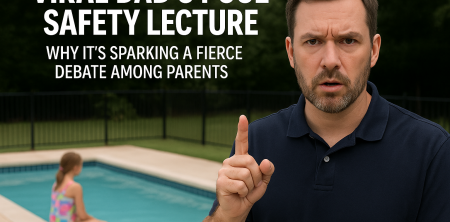
It’s a scene that’s played out in countless backyards across Australia and around the world: a child’s toy, perhaps a favorite ball, bounces over the pool fence, landing just out of reach. For many kids, the immediate instinct is to retrieve it, no matter the obstacle. But for one Australian dad, Jesse Chain, that seemingly innocent act by his three young children became a powerful, teachable moment – one that has since gone viral on TikTok, igniting a passionate debate among parents about discipline, child safety, and the absolute necessity of rigorous pool safety tips.
The video, posted by Chain’s wife, Sophia Houston, shows a visibly upset trio of children receiving a stern lecture from their dad. Their faces are streaked with tears, their shoulders slumped as Chain drives home a chilling, undeniable truth: a swimming pool, while a source of immense fun, is also a place of profound danger. His message was unequivocal: "Pool safety is no joke. It's so dangerous." The children had climbed the backyard pool fence to get their ball, a breach of one of the most fundamental rules of water safety. And Chain wasn't holding back, choosing to impress upon them the gravity of their actions in a way that left no room for misunderstanding. This raw, emotionally charged moment has resonated deeply with millions, forcing a collective reckoning with how we teach our children about life-and-death situations.
The Incident: A Ball, a Fence, and a Father's Fear
Imagine the scenario: a sunny afternoon, the kids are playing, laughter fills the air. Then, a misplaced throw, a bounce too high, and suddenly, a cherished toy is on the other side of the pool fence. For many parents, this might prompt a quick retrieval, perhaps a gentle reminder about not climbing. But Jesse Chain saw something far more sinister in his children’s actions. He recognized that the seemingly small act of scaling a fence to get a ball represented a catastrophic lapse in judgment, a direct violation of critical pool safety protocols that could, under different circumstances, have had a truly tragic outcome.
The fence, after all, isn't just a physical barrier; it's a symbol of protection, a boundary meant to keep young, curious minds safe from the inherent risks of water. When children disregard that barrier, even for something as innocuous as a ball, they’re not just breaking a rule; they’re unknowingly putting themselves in a situation where the unthinkable could happen. Chain’s reaction, therefore, wasn't just about discipline for a minor infraction. It was about instilling a primal fear, a deep-seated respect for the danger, that he hoped would prevent a future tragedy. He wasn't just angry; he was terrified on their behalf, a fear that manifested as a powerful, unforgettable lecture.
Jesse Chain's Approach: Tough Love or Too Much?
The viral video clearly shows Chain's children in distress, their tears a testament to the intensity of their father's message. He wasn't whispering or gently coaxing. He was firm, direct, and unapologetic in his delivery. He wanted them to feel the weight of his words, to understand that this wasn't a minor scolding but a life lesson. "You don't go in the pool area without an adult. Ever," he emphasized, his voice stern. "It's not a game. People die in pools." These weren't abstract concepts; they were concrete, stark warnings designed to pierce through childhood innocence and imprint themselves on their young minds.
This method, often dubbed 'tough love,' stems from a belief that some lessons are too important to deliver softly. When the stakes are literally life and death, some parents feel a more impactful, even emotionally jarring, approach is necessary to ensure the message sticks. Chain’s supporters argue that the momentary upset of a child pales in comparison to the lifelong grief of losing a child to a preventable drowning. They see his intensity as a reflection of profound love and a desperate desire to protect. But, of course, not everyone agrees, which brings us to the core of the debate.
The Online Debate: A Spectrum of Parental Opinions
The comment section of Sophia Houston’s TikTok post quickly became a battleground for differing parenting philosophies. On one side, a chorus of parents applauded Chain’s no-nonsense approach. Many shared their own harrowing experiences or fears, echoing the sentiment that when it comes to pool safety, there's no room for negotiation or gentle persuasion. One commenter wrote, "This is exactly how I would handle it. They need to understand the seriousness." Another added, "Better tears now than lifelong regret later." These parents often prioritize the immediate and lasting impact of the lesson over the momentary emotional comfort of the child, believing that the raw emotion helps solidify the warning.
Conversely, a significant contingent of viewers expressed discomfort with the intensity of Chain's discipline. They questioned whether inducing such visible distress in young children was the most effective pedagogical tool. Some suggested alternative methods, like immediate consequences (e.g., losing pool privileges), or calmer, more educational conversations about the dangers. "You can teach them without scaring them half to death," one user remarked. Others worried about the potential long-term psychological effects of such an intense confrontation, suggesting it might foster fear rather than understanding. This side of the debate often emphasizes positive reinforcement, age-appropriate explanations, and maintaining a secure, trusting emotional bond. (See: CDC Pool Safety Guidelines.)
Why Pool Safety Tips Are Non-Negotiable
Regardless of how one feels about Jesse Chain's specific disciplinary tactics, there’s one point on which everyone should agree: pool safety is an absolute, non-negotiable priority for any family with access to a pool, whether at home, a friend's house, or a public facility. Drowning remains a leading cause of accidental death for young children, particularly those under the age of five. The statistics are horrifyingly stark and should serve as a constant reminder of the vigilance required.
According to the Australian Institute of Health and Welfare, drowning is one of the leading causes of accidental death for children aged 0-14, with backyard pools being a significant location for these incidents. The U.S. Centers for Disease Control and Prevention (CDC) reports similar trends, noting that drowning is the number one cause of death for children aged 1-4. These aren't just numbers; they represent shattered families and preventable tragedies. It's not about being alarmist; it's about being realistic about a silent, swift killer. A child can drown in mere seconds, often without a splash or any audible struggle, making constant supervision and robust safety measures paramount. These are the stakes that likely fueled Jesse Chain's passionate outburst.
Beyond the Fence: Essential Pool Safety Tips Every Parent Needs
While a secure fence is the first line of defense, effective pool safety tips extend far beyond physical barriers. It’s a multi-layered approach that requires consistent effort and a comprehensive understanding of risk. Here are some essential strategies every parent should implement:
- Constant, Active Supervision: This isn't just about being in the same general area. It means designating a responsible adult as the "water watcher" who is solely focused on the children in and around the pool, without distractions like phones, books, or conversations. This adult should be within arm's reach of young children.
- Fencing and Gates: All pools should have a four-sided fence that completely isolates the pool from the house and yard. The fence should be at least 1.2 meters (approximately 4 feet) high, with self-closing and self-latching gates that open outwards. Latches should be out of a child's reach. Regularly inspect fences and gates for any damage.
- Swimming Lessons: Enroll children in age-appropriate swimming lessons as early as possible. While lessons don't make a child 'drown-proof,' they significantly reduce the risk and provide vital water competency skills.
- CPR Training: At least one adult in the household should be trained in CPR and first aid. Knowing how to respond in an emergency can be the difference between life and death.
- No Diving/Running Rules: Establish and enforce strict rules around the pool, including no running on wet surfaces and no diving in shallow areas.
- Pool Alarms: Consider installing alarms on pool gates, doors leading to the pool area, or even in-pool alarms that detect disturbances in the water.
- Remove Toys from the Pool Area: After swimming, always remove all toys from the pool and deck. Leaving them accessible can tempt children to try and retrieve them, just as Chain's children did.
- Life Jackets/Flotation Devices: For non-swimmers or weak swimmers, ensure they wear U.S. Coast Guard-approved life jackets when near or in the water. Avoid reliance on inflatable toys or arm floaties as safety devices.
- Drain Safety: Educate children about the dangers of pool drains and suction outlets. Ensure all drains have anti-entrapment covers to prevent hair or body parts from getting stuck.
- Establish Clear Rules and Consequences: Beyond the initial lecture, consistently reinforce pool rules and ensure children understand the consequences of breaking them. This builds a framework of understanding, not just fear.
The Psychology of Fear and Learning in Children
The debate around Jesse Chain’s approach touches upon a fundamental question in child development: how do children learn best, especially about danger? Some developmental psychologists argue that while fear can be a powerful motivator in the short term, it may not always be the most effective long-term teaching strategy. Chronic fear or anxiety can sometimes lead to avoidance rather than confident, safe engagement.
However, other experts might contend that for truly life-threatening risks, a strong, even fear-inducing, initial impression can be crucial, particularly for younger children who may not fully grasp abstract concepts of danger. The key often lies in balance: delivering a serious message about risk, then following up with consistent, calm reinforcement and practical safety skills. A single, intense lecture, while impactful, needs to be part of a broader, ongoing education about water safety that includes positive teaching and skill-building.
The Role of Parental Authority and Social Media Scrutiny
The viral nature of this incident also highlights the increasingly complex landscape of modern parenting. In an age where moments from private family life can instantly become public spectacles, parents find themselves under unprecedented scrutiny. Jesse Chain and Sophia Houston's decision to share such a raw, personal moment opened them up to millions of opinions, both supportive and critical. This raises questions about the boundaries of parental authority in the digital age and the pressure parents face to conform to perceived 'ideal' parenting styles.
What one family considers a necessary, loving act of protection, another might view as overly harsh. Social media amplifies these differences, often simplifying nuanced situations into binary 'good' or 'bad' judgments. It's a reminder that every family operates within its own context, and what works for one child or one parent might not work for another. The value of the video, perhaps, isn't to declare Chain's method definitively right or wrong, but to spark a vital conversation about the seriousness of pool safety and the diverse ways parents strive to keep their children safe.
Moving Forward: Reinforcing Pool Safety Tips with Empathy and Consistency
Ultimately, the goal of any parent is to ensure their children’s safety, especially around water. While Jesse Chain's method may have been controversial, his underlying message about the critical importance of pool safety is undeniable. For parents reflecting on this viral moment, it offers an opportunity to evaluate their own pool safety strategies and how they communicate these life-saving rules to their children. (See: NIH Drowning Prevention Strategies.)
Perhaps the most effective approach blends the firmness of Chain's message with consistent, empathetic reinforcement. After a stern warning about the dangers, a follow-up conversation when emotions have cooled can be incredibly powerful. This is where you can explain why the rules are so important, discuss specific pool safety tips, and reassure your child of your love and your desire to keep them safe. Regular refreshers, practical demonstrations, and leading by example are also crucial. Remember, safety isn't a one-time lecture; it's a continuous, evolving conversation that adapts as your children grow and their understanding develops. It's about instilling respect for water, not just fear, and equipping them with the knowledge and skills to enjoy it safely for a lifetime.
Expert Perspectives: Layered Protection is Key
When it comes to pool safety, experts universally advocate for a "layered approach" to protection, often referred to as "layers of protection" or "concentric circles of safety." This means relying on multiple, overlapping safety measures rather than just one. Think of it like a series of safety nets, so if one fails, another is there to catch your child. Child safety advocates and organizations like the American Academy of Pediatrics (AAP) emphasize this strategy because no single pool safety tip is foolproof.
For instance, while a fence is critical, a child might find a way over or through a damaged section. That's where active supervision becomes the next layer. If supervision lapses for a moment, swimming lessons might give a child a fighting chance to get to the side. If they still get into trouble, CPR training can be the final, life-saving layer. The Chain incident perfectly illustrates the breakdown of one layer (the fence) and the critical need for others. If the children had been taught water competency, or if an adult had been actively supervising, the outcome of their fence-climbing might have been different, even if still a serious rule breach. This multi-faceted approach isn't just a recommendation; it's a standard advocated by nearly every organization dedicated to preventing childhood drownings.
Common Misconceptions About Pool Safety
Even with abundant information, some dangerous misconceptions about pool safety persist. It's vital to address these head-on to ensure families aren't operating under false senses of security:
- "My child knows how to swim, so they're safe." While swimming lessons are incredibly important, they don't make a child 'drown-proof.' Even strong swimmers can get into trouble due to cramps, exhaustion, head injuries, or strong currents in natural bodies of water. Supervision is always necessary.
- "I'll hear them if they're in trouble." Drowning is often silent. There's rarely splashing or shouting, especially with young children. They can slip under the water quickly and silently. This is why active, visual supervision is so crucial.
- "Inflatable armbands or floaties are enough protection." These devices are toys, not safety equipment. They can give children and parents a false sense of security, can easily slip off, or deflate. Only U.S. Coast Guard-approved life jackets are designed for safety.
- "A quick dip is fine without supervision." Any time a child is near water, even for a second, active supervision is required. It only takes moments for a tragedy to occur.
- "Pool alarms replace supervision." Pool alarms are an excellent layer of protection, but they are supplemental. They alert you to a potential issue, but they don't prevent it or guarantee immediate rescue.
The Impact of Community and Public Pools
While the Chain family's incident centered on a backyard pool, pool safety tips are equally vital for community and public pools. In these settings, the responsibility often feels diffused, but it shouldn't be. Parents and guardians still have a primary role:
- Lifeguards are not babysitters: Lifeguards are there to respond to emergencies and enforce rules for a large number of people. They cannot provide the same dedicated, one-on-one supervision that a parent can. Always maintain close supervision of your children, even with lifeguards present.
- Understand pool rules: Familiarize yourself and your children with the specific rules of any public pool, such as depth markers, designated swimming areas, and age restrictions.
- Buddy system: Encourage older children to use a buddy system, but still ensure adult supervision is nearby.
- Check water clarity: If you can't clearly see the bottom of the pool, it might indicate poor water quality or filtration issues, which can also pose health risks.
Ensuring safety in public settings requires the same vigilance as at home, recognizing the unique challenges of a crowded environment.
Frequently Asked Questions About Pool Safety Tips
Let's address some common questions parents have about keeping kids safe around water.
Q1: At what age should my child start swimming lessons?
The American Academy of Pediatrics (AAP) suggests that children can start swimming lessons as early as age 1. Research shows that early swimming lessons can reduce the risk of drowning in young children. However, the most important factor is the child's readiness and the quality of the instruction. Always choose programs with certified instructors and a focus on water safety skills, not just stroke technique. (See: WHO Drowning Fact Sheet.)
Q2: How do I choose the right life jacket for my child?
Always look for a U.S. Coast Guard-approved life jacket (or the equivalent certification in your country). The label will clearly state its approval. Ensure it's the correct size for your child's weight, not just their age. It should fit snugly, so it doesn't ride up around their ears when they're in the water. Avoid inflatable toys or "water wings" as they offer no real protection against drowning.
Q3: What should I do if my child goes missing near a pool?
If a child goes missing and you have a pool, always check the pool first. Every second counts in a drowning incident. Look in and around the pool area immediately, then expand your search. This immediate action can be the difference between life and death.
Q4: How often should I check my pool fence and gate?
You should inspect your pool fence and gate regularly, ideally before each swim season and then at least monthly throughout the year. Look for any damage, loose posts, broken latches, or gaps that a child could squeeze through. Ensure the self-closing and self-latching mechanisms are working perfectly every single time.
Q5: Is a pool cover a substitute for a fence?
No, a pool cover is not a substitute for a compliant pool fence. While some automatic, rigid pool covers can provide a layer of safety, they should be used in conjunction with a fence, not instead of one. Soft covers, solar covers, and leaf covers offer no drowning protection and can actually pose an entrapment hazard. Always ensure your cover meets safety standards and is properly secured.
Q6: What's the "Water Watcher" concept, and how does it work?
The "Water Watcher" is a designated adult whose sole responsibility is to supervise children in or near the water. This person should not be distracted by phones, conversations, reading, or chores. They should wear a specific identifier, like a lanyard, to remind everyone of their role. The role can be rotated among responsible adults, but only one person at a time should be the designated Water Watcher. This prevents the dangerous assumption that "someone else is watching."
Trending Now
Frequently Asked Questions
What happened in the viral dad's pool safety lecture?
In a viral TikTok video, Australian dad Jesse Chain delivered a stern lecture to his three young children after they climbed the pool fence to retrieve a toy. The emotional moment highlighted the serious dangers of pool safety, sparking a debate among parents about how to teach children about the risks associated with swimming pools.
Why is pool safety important for children?
Pool safety is crucial for children as it helps prevent drowning and accidents. Drowning can happen quickly and silently, making it essential for kids to understand the risks associated with swimming pools. Parents like Jesse Chain emphasize the importance of teaching children about these dangers to ensure their safety during playtime.
What are some key pool safety tips for parents?
Key pool safety tips include always supervising children near water, teaching them to swim, installing pool barriers, and educating them about the dangers of climbing fences or running around the pool area. Consistent reminders and discussions about pool safety can help reinforce these important lessons.
How should parents talk to children about pool dangers?
Parents should approach discussions about pool dangers with clarity and seriousness, emphasizing the potential consequences of unsafe behavior. Using real-life scenarios, like Jesse Chain's lecture, can help children understand the importance of safety rules and encourage them to take water safety seriously.
What is the impact of viral parenting videos on discussions about child safety?
Viral parenting videos, such as Jesse Chain's pool safety lecture, can significantly impact public discourse on child safety. They often spark discussions among parents about effective discipline, safety measures, and best practices for teaching children about risks, prompting a collective reevaluation of parenting approaches.
What's your take on this? Share your thoughts in the comments below — we read every one.


0 Responses