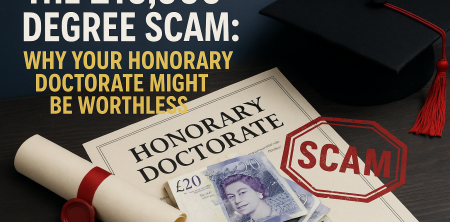
When you're trying to stand out in today's cutthroat job market, every credential feels like it counts. You're constantly looking for that edge, that little something extra that makes your resume pop. For years, a doctorate — whether earned through sweat and tears or bestowed for significant achievements — has been seen as the pinnacle of academic distinction. But what if that distinction is being sold off, cheapening its value and raising serious questions about what it even means to hold a "doctorate"?
Lately, there's been a troubling trend unearthed by a Times Higher Education investigation: online businesses are now peddling honorary doctorates for fees that can climb as high as £10,000. These outfits promise to "enhance the reputation" of their buyers. The entire situation throws a wrench into the long-standing debate about an honorary doctorate vs traditional degree, forcing us to re-evaluate the true worth of these accolades in a world increasingly susceptible to commercialization. As someone who's spent years in education, from K-12 classrooms to university dean's offices, I can tell you this isn't just a minor academic squabble; it's a fundamental challenge to academic integrity and the very idea of earned merit.
1. The Traditional Doctorate: A Journey of Rigor and Research
Let's start with what we understand to be a traditional doctorate, like a Ph.D. or an Ed.D. This isn't just a piece of paper you pick up after a few classes. It's an arduous, multi-year commitment to advanced study, original research, and the creation of new knowledge. You're talking about comprehensive exams that test the depths of your understanding, a dissertation that often stretches for hundreds of pages and represents a significant contribution to your field, and a defense of that dissertation before a panel of seasoned academics.
The value here isn't just in the title; it's in the process. It's in the critical thinking skills you hone, the research methodologies you master, and the sheer intellectual endurance you develop. Employers, especially in academia, research, or highly specialized fields, recognize this. They know that someone with a traditional doctorate has proven their ability to tackle complex problems, conduct independent scholarly work, and persevere through significant intellectual challenges. That's a skillset, not just a credential, and it speaks volumes about a candidate's capabilities.
Think about the real-world application of these skills. A Ph.D. in a scientific field means a person has spent years designing experiments, analyzing data, and interpreting results, often pushing the boundaries of human knowledge. An Ed.D. holder has rigorously studied educational theory, policy, and practice, developing the expertise to lead schools or reform curricula. These aren't just academic exercises; they are intense training for careers that demand high-level analytical and problem-solving abilities. The dissertation process itself is a masterclass in project management, independent work, and effective communication of complex ideas – skills that are invaluable in any advanced professional role. It's about demonstrating mastery, not just accumulating credits.
2. The Honorary Doctorate: A Symbol of Recognition, Not Qualification
Now, an honorary doctorate is a completely different beast. Traditionally, these are conferred by universities upon individuals who have made extraordinary contributions to society, culture, science, or public service. Think of Nobel laureates, groundbreaking artists, influential philanthropists, or former heads of state. It's a way for an institution to acknowledge and celebrate remarkable achievement, often bringing prestige to the university itself by associating with such distinguished figures.
Crucially, an honorary doctorate isn't earned through academic coursework, exams, or a dissertation. It's an honor, a symbolic gesture. It doesn't qualify someone to teach at a university, conduct research, or practice in a licensed profession based solely on that title. While it adds a certain luster to a public figure's profile, it doesn't signify the same academic rigor or specific expertise that a traditional degree does. This distinction is absolutely vital, especially when we're comparing an honorary doctorate vs traditional degree in a professional context.
To put it simply, an honorary doctorate is like a lifetime achievement award. When a university bestows an honorary Doctor of Humane Letters (L.H.D.) on someone like Oprah Winfrey, it's not because she submitted a dissertation on media studies. It's because her work has had a profound impact on culture and public discourse. Similarly, when a university honors a philanthropist with a Doctor of Laws (LL.D.), it's recognizing their significant contributions to society, not their legal scholarship. These awards are about celebrating impact and inspiration, not validating academic mastery. They enrich the university's commencement ceremonies and inspire graduates, but they don't change the recipient's professional qualifications or academic standing in the same way an earned degree does.
3. The Rise of the "Pay-to-Play" Honorary Doctorate Mill
Here's where things get murky and, frankly, infuriating. The Times Higher Education investigation revealed that a growing number of online businesses are actively selling these honorary doctorates. We're not talking about obscure, fly-by-night operations; these are entities charging significant sums – up to £10,000 – with the explicit promise of "enhancing the reputation" of the buyer. This isn't about recognizing genuine achievement; it's about monetizing a prestigious academic accolade.
This "pay-to-play" model fundamentally undermines the integrity of the honorary degree. It transforms a gesture of profound respect and recognition into a commodity. When you can simply buy the title, regardless of your actual contributions, what does that say about the value of the honor itself? It creates a system where those with financial means can acquire a veneer of academic distinction without doing any of the actual work or making any of the significant societal contributions that traditionally warrant such an award.
The problem is exacerbated by the often-vague language these "degree mills" use. They might claim to be affiliated with obscure "universities" or "institutes" that have no legitimate accreditation or academic standing. They leverage the general public's lack of awareness about the strict protocols surrounding legitimate degree conferrals. For someone unfamiliar with the academic landscape, the appeal of a quick, expensive "honorary doctorate" might seem like a legitimate shortcut to prestige. But these aren't shortcuts; they're dead ends that can damage reputations and mislead employers. The entire enterprise preys on aspiration and misunderstanding, turning a genuine honor into a hollow transaction.
4. Academic Integrity Under Siege: The Devaluation of Degrees
The most immediate and damaging consequence of this commercialization is the devaluation of academic integrity. Universities carefully guard the sanctity of their degrees, both earned and honorary. When a title that implies significant achievement can be purchased online, it cheapens the entire enterprise. It creates cynicism and distrust, not just among employers but among the general public. (See: the rise of honorary degrees.)
Think about the individual who spent years slogging through a Ph.D. program, sacrificing income, social life, and sleep, only to see someone else buy a similar-sounding title for a few thousand pounds. It's an insult to their dedication and hard work. More broadly, it erodes public confidence in educational credentials at a time when skepticism about institutions is already high. If a "doctorate" can be bought, what else can be? This controversy around the honorary doctorate vs traditional degree isn't just about a title; it's about the very foundation of trust in our educational system.
This erosion of trust has far-reaching implications. For legitimate universities, it means their hard-won reputations are at risk of being tarnished by association. For employers, it means having to spend more time verifying credentials, increasing the cost and complexity of hiring. And for society as a whole, it means a weakening of the meritocratic principles that education is supposed to uphold. When the lines between genuine achievement and purchased prestige blur, it becomes harder for anyone to discern true expertise. This isn't just a threat to the academic world; it's a threat to any profession that relies on demonstrated knowledge and skill. For more context, see sweeping new restrictions on university research funding.
5. The Unsuspecting "Recipient": A Disturbing Twist
Perhaps one of the most ethically charged aspects of this scandal is the revelation that some individuals have been "shocked" to find their profiles listed as recipients of these honorary doctorates without their knowledge or consent. Imagine that! You're going about your life, and suddenly you discover that some online outfit has slapped a "Dr." in front of your name and listed you as having an honorary degree from some obscure institution, all without your permission.
This raises serious questions about identity theft, reputation management, and the shadowy nature of these operations. It's one thing to knowingly buy a questionable credential, but it's another entirely to be involuntarily associated with one. This practice could easily lead to professional embarrassment or even legal complications for those unknowingly caught in its web. It underscores the predatory nature of some of these online "degree mills" and the lack of ethical oversight in this burgeoning market.
The implications of this involuntary conferral are serious. For example, if a legitimate professional is unknowingly listed with a fake honorary doctorate, it could raise red flags with licensing boards or professional organizations. Their employer might question their integrity, even if they had no knowledge of the "award." It's a clear violation of personal and professional autonomy. These operations aren't just selling fake degrees; they're actively manipulating public perception and potentially damaging the reputations of innocent people. This level of deceit highlights the urgent need for greater scrutiny and regulation of these online entities.
6. Navigating the Job Market: The Perils of Misrepresentation
For job seekers, the distinction between an honorary doctorate vs traditional degree has never been more critical. In today's competitive market, employers are scrutinizing credentials like never before. If you present an honorary doctorate, especially one obtained through a questionable online source, you're walking a very fine line. While a legitimate, university-conferred honorary degree from a reputable institution can certainly add gravitas to a profile, a purchased one is a different story entirely.
Misrepresenting an honorary degree as an earned academic one could lead to serious consequences, including rescinded job offers, termination, and damage to one's professional reputation. Savvy employers and HR professionals are increasingly aware of these online scams. They'll conduct due diligence, and if they uncover that a "doctorate" was purchased rather than earned or legitimately bestowed, it reflects incredibly poorly on the candidate's honesty and judgment. It's just not worth the risk.
Imagine being in an interview where you've proudly listed your "Doctorate" on your resume, only for the interviewer to ask specific questions about your dissertation or your research methodology. If you've only "purchased" the title, you'd be immediately exposed. This isn't just about a lack of academic knowledge; it's about a fundamental lack of integrity, which is a massive red flag for any employer. In sectors like education, healthcare, or research, where trust and expertise are paramount, such misrepresentation can be career-ending. The risk of being caught, and the subsequent damage to your professional standing, far outweighs any perceived benefit of a fake credential.
7. The True Value: Skills, Experience, and Authenticity
So, where does this leave us in the honorary doctorate vs traditional degree debate? Ultimately, the true value in the professional world doesn't come from a title alone, especially one that can be bought. It comes from demonstrable skills, relevant experience, and genuine authenticity. A traditional doctorate provides a framework for developing deep expertise and research capabilities that are highly valued in specific sectors.
An honorary doctorate, when legitimately awarded, is a public acknowledgment of a lifetime of impactful work. Neither of these, however, can be replicated by a purchased credential. Employers are looking for what you can *do*, not just what you claim to *be*. They want to see a track record of achievement, a portfolio of work, and the ability to contribute meaningfully to their organization. These are things that can't be bought for £10,000; they have to be earned through effort, talent, and integrity.
In my experience, the most successful individuals are those who continuously develop their skills, seek out challenging experiences, and approach their work with genuine passion. A degree, whether traditional or honorary, serves as a marker of achievement, but it's the underlying capabilities and character that truly define a person's professional worth. When I look at a resume, I'm not just looking for titles; I'm looking for evidence of problem-solving, leadership, creativity, and a commitment to lifelong learning. These are the qualities that build lasting careers and make a real difference, not a fraudulently obtained piece of paper.
8. The Broader Commercialization of Education
This trend of selling honorary doctorates isn't an isolated incident; it's part of a larger, more troubling pattern in the commercialization of education. We're seeing everything from unaccredited online degrees to dubious certification programs proliferate, all promising quick routes to career advancement. While legitimate online education has its place and offers incredible accessibility, this shadowy underbelly preys on aspirations and exploits the desire for upward mobility.
As educators, we have a responsibility to uphold the standards of our profession and to educate the public about the difference between legitimate credentials and commercial scams. The push for profit in education, if left unchecked, risks eroding the very foundations of trust and quality that define genuine learning institutions. It's a delicate balance, and right now, the scales are tipping in a concerning direction, challenging the fundamental comparison of an honorary doctorate vs traditional degree.
This commercialization isn't limited to fake doctorates. We've seen a rise in "diploma mills" that offer full degrees for little to no academic work, often targeting international students or those desperate for a credential. There are also predatory for-profit institutions that saddle students with massive debt for degrees that hold little value in the job market. This landscape creates a minefield for students and job seekers trying to make informed decisions. It's a stark reminder that not all educational opportunities are created equal, and the pursuit of profit can often overshadow the pursuit of genuine learning and academic excellence. We must advocate for strong accreditation standards and consumer protection to safeguard the integrity of education. (See: the value of honorary degrees.)
9. Protecting Your Professional Profile: Due Diligence is Key
For individuals, the lesson here is clear: exercise extreme caution and conduct thorough due diligence when considering any educational credential, especially one that seems too good to be true. If you're approached with an offer for an honorary doctorate that requires a fee, or if you encounter any program that promises a quick and easy path to a prestigious title, run the other way. Legitimate universities do not sell honorary degrees; they bestow them based on merit.
Always verify the accreditation of any institution offering degrees, and be skeptical of any claim that seems to bypass the traditional academic requirements. Your professional reputation is one of your most valuable assets, and associating it with a questionable credential can have long-lasting, detrimental effects. In the debate between an honorary doctorate vs traditional degree, the integrity of your personal brand should always be your top priority. For more context, see the reckless plan to gut Head Start.
A simple check can save you a lot of grief. Look up the institution on government-recognized accreditation databases. For example, in the United States, you'd check with the Council for Higher Education Accreditation (CHEA) or the U.S. Department of Education. If an institution isn't listed or its accreditation is from a questionable agency, that's a huge red flag. Also, be wary of institutions that promise degrees based solely on "life experience" or offer instant degrees without any rigorous assessment. Real education takes time, effort, and verification. Don't let the allure of a quick title compromise your long-term professional standing.
10. The Legal and Ethical Ramifications for Institutions
Legitimate universities that confer honorary degrees operate under strict ethical guidelines. They have committees that meticulously review candidates, considering their public service, scholarly contributions, artistic achievements, or philanthropic endeavors. This process is transparent and based on merit, not money. The legal implications for institutions that might inadvertently (or knowingly) associate with these "pay-to-play" schemes are significant.
A university's reputation is its most valuable asset. If it's discovered that an institution, even tangentially, is involved in a scheme that sells honorary degrees, it could face severe backlash. This might include a loss of accreditation, public condemnation, a decrease in student enrollment, and even legal challenges from students or alumni who feel their legitimate degrees have been devalued. The ethical imperative to maintain academic standards is not just about abstract principles; it has very real, tangible consequences for the sustainability and credibility of educational institutions.
For instance, an institution could face lawsuits for false advertising if it allows its name to be used in conjunction with these dubious awards. Regulatory bodies could impose fines or sanctions. More importantly, the trust of its own faculty, staff, and students could be irrevocably damaged. It's a reminder that upholding academic integrity is a continuous effort, requiring vigilance and a steadfast commitment to ethical practices, especially in an era where digital platforms can so easily be exploited for fraudulent purposes.
11. Expert Perspectives on Credentialing and Reputation
When we talk about an honorary doctorate vs traditional degree, it's worth considering what various experts in education and human resources have to say. Many HR professionals now use sophisticated background check services that can quickly identify unaccredited institutions or fraudulent claims. They often prioritize skills-based hiring and demonstrable work experience over questionable credentials.
According to a report by the Society for Human Resource Management (SHRM), employers are increasingly concerned about resume fraud, with educational misrepresentation being a top concern. This means they're more likely to thoroughly vet academic claims. Academic experts, particularly those in higher education leadership, consistently emphasize the importance of earned degrees as markers of specific competencies and rigorous training. They see the commercialization of honorary degrees as a direct attack on the academic ecosystem's foundational principles.
For me, having spent years as a dean and professor, the distinction is crystal clear. A traditional doctorate represents a transformation of the individual – a rigorous intellectual journey that changes how they think and approach problems. An honorary degree, when legitimate, is a celebration of a life already lived impacting the world. The former is a qualification; the latter is an honor. The blurring of these lines by "degree mills" isn't just confusing; it's actively harmful to both individuals and institutions. We need a collective effort to educate the public and tighten regulations to protect the integrity of all academic credentials.
12. The Global Impact: A Worldwide Problem
This issue of fake degrees and "pay-to-play" honorary doctorates isn't confined to one country or region; it's a global phenomenon. Investigations have uncovered such operations across continents, often targeting individuals in developing nations who may be less familiar with Western academic standards or more susceptible to the promise of quick upward mobility.
The internet makes it incredibly easy for these fraudulent entities to operate across borders, making enforcement and regulation a significant challenge. International bodies and educational organizations are increasingly collaborating to share information and combat these scams. However, the sheer scale of the problem means that individuals must remain their first line of defense.
Consider the impact on international student mobility or immigration processes. A fake degree can lead to visa denials, deportation, or severe legal penalties. It undermines the legitimate efforts of millions of students and professionals who genuinely strive for international recognition of their qualifications. This global dimension underscores the urgency of addressing the problem, not just locally, but through concerted international efforts to protect academic standards worldwide.
Frequently Asked Questions About Honorary vs. Traditional Doctorates
Q1: What's the fundamental difference between an honorary doctorate and a traditional doctorate?
The core difference is simple: a traditional doctorate (like a Ph.D. or Ed.D.) is earned through years of rigorous academic study, original research, comprehensive exams, and a defended dissertation. It signifies specialized expertise and a contribution to knowledge. An honorary doctorate, on the other hand, is an award bestowed by a university to recognize someone's significant contributions to society, culture, or public service, without requiring academic coursework or research. It's an honor, not an academic qualification.
Q2: Can someone with an honorary doctorate legitimately use the title "Dr."?
Yes, generally, individuals who have received a legitimate honorary doctorate can use the title "Dr." as a courtesy. However, it's crucial for them to clarify that it's an honorary title, especially in professional contexts where academic qualifications are expected. Misrepresenting an honorary degree as an earned academic one can lead to ethical issues and professional consequences.
Q3: Do employers value an honorary doctorate the same way they value a traditional one?
No, not at all in terms of academic qualification. Employers, particularly in academia, research, or highly specialized fields, understand that a traditional doctorate signifies deep expertise and research capabilities. An honorary doctorate, while impressive if genuinely awarded by a reputable institution, doesn't convey the same academic or professional qualifications. It's seen as a recognition of achievement, not a qualification for a specific role requiring academic rigor.
Q4: How can I tell if an honorary doctorate offer is legitimate or a scam?
A legitimate honorary doctorate is never for sale. If you're asked to pay a fee for an honorary degree, it's almost certainly a scam. Legitimate honorary degrees are conferred by accredited, reputable universities, usually following a rigorous nomination and review process by the institution's governing body. Be wary of online "universities" with no recognized accreditation, promises of instant degrees, or offers based solely on "life experience." Always verify the awarding institution's legitimacy and accreditation.
Q5: What are the risks of obtaining a "pay-to-play" honorary doctorate?
The risks are significant and can severely damage your professional reputation. You could face accusations of misrepresentation or fraud, especially if you try to pass it off as an earned degree. Employers, licensing boards, and professional organizations are increasingly adept at identifying fake credentials, which could lead to rescinded job offers, termination, or damage to your career and public image. It also devalues the hard work of those who genuinely earn their doctorates.
Q6: If I unknowingly received a fake honorary doctorate, what should I do?
If you discover you've been involuntarily or unknowingly associated with a fake honorary doctorate, it's important to take immediate action. First, remove any mention of it from your professional profiles (resume, LinkedIn, personal website). Consider contacting the entity that listed you and demanding they remove your name. You might also want to consult with a legal professional, especially if you believe your identity has been used without your consent or if you've suffered professional harm.
Q7: What role does accreditation play in the legitimacy of a doctorate?
Accreditation is absolutely vital. For traditional degrees, it ensures that an educational institution meets recognized standards of quality and rigor. Degrees from unaccredited institutions are often not recognized by employers, other universities, or professional licensing boards. While honorary degrees don't require accreditation in the same way, the legitimacy of the honorary degree itself is tied directly to the reputation and accredited status of the awarding university. A legitimate honorary degree comes from a legitimate, accredited institution.
The integrity of academic credentials is a cornerstone of our professional world. When that integrity is compromised by commercial interests, it impacts everyone. We need to be vigilant, both as individuals seeking advancement and as institutions committed to genuine education, to ensure that titles truly reflect accomplishment, not just financial transactions. The real worth, after all, lies in what you've truly learned and achieved, not what you've purchased.
Trending Now
Frequently Asked Questions
What is an honorary doctorate?
An honorary doctorate is a degree awarded to individuals as a recognition of their significant contributions to a specific field or society, rather than through traditional academic study or research. These degrees are often given during ceremonies and do not require the recipient to fulfill the usual academic requirements of a traditional doctorate.
Are honorary doctorates worth anything?
The value of honorary doctorates is debated. While they can enhance an individual's reputation and credibility in certain contexts, they do not carry the same academic weight as traditional doctorates, which require rigorous study and research. The commercialization of honorary doctorates raises questions about their true worth and integrity.
How much do honorary doctorates cost?
Recent investigations have revealed that some online businesses are charging up to £10,000 for honorary doctorates. These fees are often marketed as a means to enhance an individual's reputation, but they contribute to the growing concern about the devaluation of academic credentials.
What is the difference between an honorary doctorate and a traditional doctorate?
The primary difference lies in the path to obtaining the degree. A traditional doctorate requires years of rigorous study, original research, and comprehensive examinations, while an honorary doctorate is awarded based on accomplishments and contributions without the need for academic work.
Why is the value of a doctorate being questioned?
The rise of businesses selling honorary doctorates for high fees has prompted a reevaluation of what it means to hold a doctorate. This trend raises concerns about academic integrity and the dilution of merit, as it blurs the lines between earned and purchased academic accolades.
What's your take on this? Share your thoughts in the comments below — we read every one.

