```html
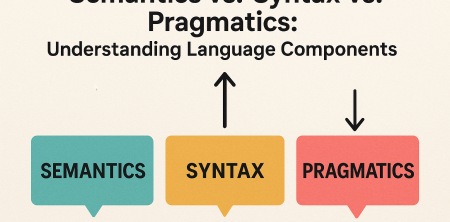
Language is a fascinating and complex system that allows humans to convey meaning, share ideas, and connect with one another. Within this intricate web, three critical components stand out: semantics, syntax, and pragmatics. Understanding these elements is essential for anyone interested in linguistics, communication, or even artificial intelligence. In this article, we'll explore semantics vs syntax vs pragmatics in depth, highlighting their definitions, roles, and significance in effective communication.
1. Defining Semantics: The Study of Meaning
Semantics is primarily concerned with meaning—the essence of what words convey. It examines how words, phrases, and sentences create meaning within language. At its core, semantics is about understanding the relationship between signs and what they represent, focusing on the meanings behind those signs.
There are two primary branches of semantics: lexical semantics and compositional semantics. Lexical semantics studies word meanings and their relationships, such as synonyms, antonyms, and hyponyms. For instance, the words “car” and “automobile” are synonyms, meaning they represent the same concept. Compositional semantics, on the other hand, looks at how phrases and sentences derive meaning from the combination of individual words. For example, the phrase “The cat sat on the mat” has a clear meaning derived from the specific words and their arrangement.
Understanding semantics is particularly important in various fields, such as literature and law, where precise meaning is crucial. In literature, authors often play with semantic concepts to create layered meanings or to evoke different emotional responses based on word choice. In legal contexts, the exact meaning of terms can significantly alter the interpretation of laws and contracts, underscoring the importance of semantics in ensuring clarity and preventing disputes.
2. Understanding Syntax: The Structure of Language
Syntax deals with the arrangement of words and phrases to create well-formed sentences in a language. It is the set of rules that dictates how words combine, including the order in which they appear. Syntax is crucial because it informs how listeners and readers interpret sentences, determining clarity and coherence.
For instance, consider the difference between the sentences “The dog chased the cat” and “The cat chased the dog.” While both sentences contain the same words, their syntactic structures lead to entirely different meanings. Syntax not only shapes how we construct sentences but also how we understand them, highlighting its vital role in effective communication.
Different languages exhibit unique syntactic structures. For example, English typically follows a Subject-Verb-Object (SVO) order. In contrast, languages like Latin can have more flexible syntactic arrangements due to their inflectional nature, where the endings of words convey grammatical relationships. This flexibility can create rich poetic forms or complex sentence structures that challenge readers and writers to think creatively about language.
3. What is Pragmatics?: Contextual Language Use
Pragmatics goes beyond semantics and syntax by considering the context in which language is used. It examines how context influences the interpretation of meaning, acknowledging that words can convey different meanings in different situations. Pragmatics involves understanding the intentions behind utterances, the relationship between speakers, and the social norms governing conversation.
For example, the phrase “Can you pass the salt?” is a polite request in a dining context. However, without the proper context, the listener might interpret it as a simple question about the listener’s ability to pass the salt. This illustrates how pragmatics emphasizes the significance of context in communication, highlighting that language is not just about words and structure.
In addition to familiarity with context, pragmatics also involves understanding conversational implicatures—those unspoken rules that guide interactions. For instance, if someone responds to an invitation with, “I have to wash my hair,” it may imply reluctance to attend, even if not explicitly stated. This understanding expands our communication toolkit, allowing us to engage more deeply and meaningfully with others.
4. The Interplay Between Semantics, Syntax, and Pragmatics
While semantics, syntax, and pragmatics are distinct areas of study, they are deeply interconnected. Effective communication relies on an understanding of all three components. Take, for example, the following sentence: “I didn’t say she stole my money.” Depending on which word is emphasized, the meaning can change entirely. This demonstrates the interplay between syntax (the structure of the sentence), semantics (the meaning of the words), and pragmatics (the context and intention behind the statement).
Without recognizing how these components interact, miscommunication can easily occur. A speaker may intend one meaning while the listener interprets another, leading to misunderstandings. Thus, a comprehensive understanding of semantics vs syntax vs pragmatics can improve both written and verbal communication. (See: Wikipedia article on semantics.)
Furthermore, this interplay can be observed in humor, where the unexpected combination of semantic meaning and syntactic structure can elicit laughter. Puns, for instance, often rely on the dual meanings of words (semantics) and their placement within a sentence (syntax) to create humor that is appreciated differently based on the audience's context and cultural background (pragmatics).
5. Real-World Applications: How These Concepts Affect Communication
In real-world scenarios, the distinctions between semantics, syntax, and pragmatics play significant roles in diverse fields such as education, artificial intelligence, and interpersonal communication. For example, in the classroom, teachers must consider all three components to effectively convey information and ensure student comprehension. This includes choosing the right words (semantics), using proper sentence structure (syntax), and understanding the context of student responses (pragmatics).
In artificial intelligence, particularly in natural language processing, understanding these concepts is crucial for developing systems that can accurately interpret human language. AI models must be trained to recognize the nuances of semantics, syntax, and pragmatics to effectively communicate and understand human intent. This highlights the increasing relevance of these linguistic components in technology and modern communication methods.
Moreover, the application of these principles extends to fields like marketing and advertising, where understanding consumer language and context can significantly affect how messages are received. Marketers leverage semantics to carefully choose words that resonate with target audiences, employing syntactic structures that enhance clarity and engagement, while also considering the pragmatic aspects of timing and cultural relevance.
6. Challenges in Distinguishing Between Components
Despite the clear definitions of semantics, syntax, and pragmatics, distinguishing between them can sometimes be challenging. For instance, polysemy—where a single word has multiple meanings—can complicate semantic interpretation. Additionally, ambiguity in syntax can lead to multiple possible interpretations of a sentence. Pragmatics adds another layer of complexity, as the same sentence can yield different meanings based on context.
Consider the statement, “It’s cold in here.” Depending on the situation, the speaker may be expressing discomfort, requesting to close a window, or merely making an observation. This ambiguity illustrates why understanding the interplay between semantics, syntax, and pragmatics is essential for effective communication. Training in these areas can help individuals recognize and navigate potential misunderstandings.
Furthermore, the digital age has introduced new challenges in communication. Text-based communication lacks the non-verbal cues present in face-to-face interactions, making it difficult to discern meaning and intent. For instance, sarcasm often relies heavily on tone and facial expressions (pragmatics), which can be lost in written formats. As a result, individuals must develop a heightened awareness of these linguistic components when communicating online, to avoid confusion and misinterpretation.
7. The Future of Linguistic Research: Trends and Innovations
Linguistic research continues to evolve, with ongoing studies aiming to deepen our understanding of semantics vs syntax vs pragmatics. Recent advancements in technology, particularly in AI and machine learning, are driving innovations in natural language understanding. Researchers are exploring how to better model human-like comprehension by integrating these linguistic elements into AI systems.
Moreover, interdisciplinary approaches are gaining traction, with linguists collaborating with psychologists, computer scientists, and cognitive scientists to explore how language functions in the brain. These collaborations are paving the way for a more comprehensive understanding of language, enhancing our ability to communicate effectively across various domains.
Another exciting trend is the exploration of multilingualism and how semantics, syntax, and pragmatics operate across different languages. Studies are revealing how bilingual or multilingual individuals navigate between languages, adjusting their understanding of meaning and context based on their linguistic backgrounds. This research not only enriches our knowledge of language but also informs education and language acquisition strategies.
8. Cultural Nuances in Language: The Role of Context
Cultural factors significantly influence how semantics, syntax, and pragmatics manifest in language. Different cultures have unique ways of expressing meaning, which can affect communication styles. For example, some cultures may prioritize directness, while others value indirect communication. Understanding these nuances is crucial for effective cross-cultural communication.
For instance, in some Asian cultures, a person might use a vague response as a way of maintaining harmony, which can be misinterpreted by someone from a more direct culture. This highlights the importance of pragmatics in understanding cultural contexts and the subtleties in communication that arise from differing cultural backgrounds.
Additionally, idiomatic expressions often reflect cultural values and history, illustrating how semantics can change drastically between cultures. Understanding these idioms requires not only knowledge of the language but also a grasp of the cultural context that shapes their meanings. For example, the English idiom “kick the bucket” means to die but might perplex someone unfamiliar with its cultural significance. This emphasizes the importance of cultural competence in effective communication. (See: MIT Linguistics Department.)
9. Practical Tips for Enhancing Communication
To improve your communication skills, it’s essential to recognize the roles of semantics, syntax, and pragmatics. Here are a few practical tips:
- Expand your vocabulary: A richer vocabulary enhances semantic understanding, allowing you to express nuanced meanings.
- Practice sentence structure: Understanding and using varied sentence structures can improve clarity and engagement in your writing and speaking.
- Consider context: Always think about the context in which you are communicating. This awareness can help you choose the right words and structure your sentences appropriately.
- Engage in active listening: Pay attention to the speaker’s intent and the contextual clues to grasp the full meaning of their message.
- Be mindful of tone and body language: In face-to-face communication, non-verbal cues can significantly alter meaning, so be aware of how your tone, facial expressions, and gestures contribute to your message.
By focusing on these elements, you can enhance your communication skills and foster more meaningful connections with others.
10. FAQs About Semantics, Syntax, and Pragmatics
What is the main difference between semantics and syntax?
Semantics focuses on the meaning of words and phrases, while syntax deals with how those words and phrases are arranged to form sentences. Together, they help convey a clear message.
How does pragmatics differ from semantics?
Pragmatics considers context and the intentions behind utterances, while semantics is concerned solely with the meanings of the words themselves. Pragmatics helps us understand how the same phrase can imply different meanings depending on the situation.
Can you give an example of how syntax can change meaning?
Sure! The sentences “The boy chased the dog” and “The dog chased the boy” use the same words but differ in meaning due to their syntax. The arrangement of words changes who is doing the chasing, illustrating how syntax impacts understanding.
Why is understanding these concepts important in communication?
Understanding semantics, syntax, and pragmatics enhances clarity and effectiveness in communication. Being aware of these elements helps in avoiding misunderstandings and fosters more meaningful interactions.
Are there any overlaps between semantics, syntax, and pragmatics?
Yes, these components often overlap. For example, the meaning of a sentence (semantics) can change based on its structure (syntax) and the context in which it’s spoken (pragmatics). A comprehensive grasp of all three is essential for effective communication.
11. Exploring the Nuances of Semantics
Semantics is a broad field that covers various topics, including denotation and connotation. Denotation refers to the literal meaning of a word, while connotation involves the additional meanings or emotions that a word may evoke. For example, the word “home” denotes a physical structure where one lives, but it connotes warmth, family, and safety for many people.
Another interesting aspect of semantics is the role of context. Words can shift meaning dramatically depending on their context. For instance, the word “light” can refer to something bright, or it can mean something that has a low weight. Understanding these nuances allows speakers and writers to convey more precise meanings and to avoid ambiguity.
Additionally, semantics includes the study of truth conditions, which explores how the truth of a statement can be determined based on the meanings of the words involved. This is particularly relevant in philosophy and logic, where the truth-value of propositions is crucial to analyzing arguments.
12. Syntax Variations Across Languages
Each language has its unique syntactic rules, which can lead to fascinating variations in sentence structure. For instance, in Japanese, the typical sentence order is Subject-Object-Verb (SOV), which contrasts with the SVO structure of English. This difference can lead to challenges for learners of either language, as they must adapt to new syntactic conventions. (See: ScienceDirect on semantics topics.)
Another notable example is the use of 'wh-movement' in English, where interrogative words like “who” or “what” are moved to the beginning of a question. In contrast, other languages may not require such movement, affecting how questions are formed and understood. This highlights how syntax is not just about order but also about the rules and conventions that govern language use.
13. Pragmatics in Everyday Communication
Pragmatics plays a significant role in everyday communication, influencing how we engage with one another. For instance, when someone asks, “Do you want to go for a walk?” the pragmatic interpretation may depend on various factors, such as the relationship between the speakers and the context of the conversation. The question could imply a desire for companionship, a need to discuss something privately, or simply an invitation to enjoy nature.
Moreover, politeness strategies are grounded in pragmatics. Different cultures have varying norms regarding politeness, which can significantly affect how requests and refusals are framed. Understanding these pragmatic norms can help individuals navigate social interactions more effectively, fostering smoother communication.
Conversational analysis is another area within pragmatics that explores how people manage turn-taking and repair misunderstandings in dialogue. This analysis helps linguists understand the implicit rules of conversation, shedding light on how we negotiate meaning in real-time interactions.
14. Integrating Linguistics into AI
As artificial intelligence continues to advance, integrating linguistic concepts into AI systems becomes increasingly essential. Natural language processing (NLP) relies on a deep understanding of semantics, syntax, and pragmatics to create systems that can effectively engage in human-like conversations. For instance, AI chatbots must be programmed to interpret user intent accurately, which involves semantic analysis, syntactic parsing, and pragmatic understanding of context.
Recent developments in NLP models, such as GPT-3, illustrate the power of these integrations. These models leverage vast amounts of data to learn language rules and nuances, enabling them to generate coherent and contextually appropriate responses. However, challenges remain, especially in understanding humor, sarcasm, and cultural references, which require a nuanced grasp of pragmatics.
15. Conclusion: The Importance of Semantics, Syntax, and Pragmatics
Understanding semantics vs syntax vs pragmatics is not just an academic exercise; it's a vital part of effective communication in every aspect of our lives. Whether you're navigating a conversation, writing an essay, or developing an AI system, these components play a crucial role in shaping how we convey and interpret meaning.
As we continue to explore the intricacies of language, recognizing and applying these concepts can lead to improved communication skills and a deeper appreciation of the linguistic art. So, whether you're a linguist, a student, or simply someone interested in effective communication, embracing these principles will enrich your interactions and understanding of the world around you.
```
Trending Now
Frequently Asked Questions
What is the difference between semantics and syntax?
Semantics focuses on the meaning of words and sentences, while syntax deals with the structure and rules governing how words are arranged in sentences. Understanding both is crucial for effective communication, as semantics provides the meaning and syntax ensures that the meaning is conveyed correctly.
What does pragmatics mean in linguistics?
Pragmatics studies how context influences the interpretation of meaning in communication. It goes beyond the literal meanings of words to consider factors like tone, situation, and intent, which can significantly alter how messages are understood.
Why are semantics, syntax, and pragmatics important?
These components are vital for effective communication. Semantics ensures clarity of meaning, syntax provides structure to language, and pragmatics adds context, helping individuals convey and interpret messages accurately in various scenarios.
How does semantics relate to artificial intelligence?
In artificial intelligence, semantics plays a crucial role in natural language processing. Understanding the meaning of words and phrases helps AI systems interpret user queries more accurately, enabling better communication between humans and machines.
What are the branches of semantics?
Semantics has two main branches: lexical semantics, which studies word meanings and their relationships, and compositional semantics, which examines how the meanings of phrases and sentences arise from the combination of individual words.
Agree or disagree? Drop a comment and tell us what you think.

