```html
When you dig into the world of language, you often hear the terms syntax and grammar tossed around, sometimes interchangeably. But there’s a significant distinction between the two that can impact how you understand and use language. Understanding the difference between syntax vs grammar is crucial for anyone looking to improve their writing or linguistics skills. In this article, we will break down what syntax and grammar are, explore their differences, and provide practical insights to help you master both aspects of language.
1. Defining Grammar
Grammar is the overarching system of rules that governs how we construct sentences in a language. It encompasses various elements, including word choice, sentence structure, punctuation, and the formation of tenses. Essentially, grammar dictates how we combine words to create meaning.
At its core, grammar is about correctness and clarity in communication. For example, in English, the correct usage of subject-verb agreement (like saying 'She runs' instead of 'She run') demonstrates how grammar rules help in conveying precise information. Understanding grammar is not only essential for writing but also for speaking effectively.
2. What is Syntax?
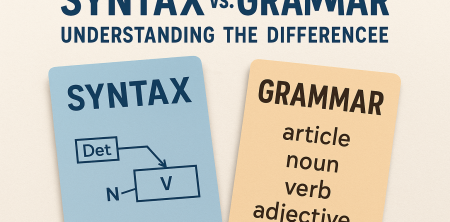
Syntax, on the other hand, is a subset of grammar. It specifically deals with the arrangement of words and phrases to create well-formed sentences. Syntax is focused on the structure rather than the individual components. For example, the sentence 'The cat chased the mouse' is structurally sound in English due to its adherence to syntactic rules.
Every language has its own unique syntactic rules. For instance, while English typically follows a Subject-Verb-Object order, other languages like Japanese can use Subject-Object-Verb. Understanding syntax is crucial for mastering the nuances of a language and for forming sentences that sound natural to native speakers.
3. The Relationship Between Syntax and Grammar
The relationship between syntax and grammar can be likened to that of a puzzle. Grammar provides the overall picture and the rules, while syntax focuses on how the individual pieces fit together. Syntax is one way in which grammar is realized. For example, incorrect syntax can lead to grammatically correct sentences that are nonsensical, such as 'Colorless green ideas sleep furiously,' famously used by Noam Chomsky to illustrate the point.
While grammar includes rules about syntax, it also encompasses other areas such as morphology (the structure of words) and phonology (the sound system of a language). Therefore, while they are interconnected, they are not the same. Recognizing this distinction can enhance your understanding of linguistic studies and improve your command of any language.
4. Examples of Syntax vs Grammar
To better grasp how syntax and grammar function, let’s take a look at some examples. Consider the sentence: 'The dog barked loudly.' The grammar of this sentence is correct; it follows the rules of English. However, if we rearranged it to say 'Loudly barked the dog,' we are still adhering to grammatical rules but altering the syntax.
Another example is: 'She loves chocolate.' This sentence is grammatically correct and follows the standard syntax. However, if we change it to 'Chocolate loves she,' we break both the grammatical rules and the syntactic structure, making it incorrect. These examples illustrate how syntax plays a role in the effectiveness and clarity of communication.
5. Common Misunderstandings
One common misunderstanding is that grammar is merely about the rules one must follow to avoid being wrong. While that’s part of it, it’s also about clarity and conveying meaning effectively. Syntax is often painted as overly rigid when it’s actually about the fluidity of language and how meaning can be constructed. (See: Understanding the concept of grammar.)
Another misconception is that one can ignore one for the other. Many believe they can write well without focusing on syntax, thinking that grammar alone will suffice. However, a well-written piece requires both to ensure that ideas are communicated clearly and effectively.
6. The Importance of Mastering Both
Mastering both syntax and grammar can significantly enhance your writing and communication skills. For instance, in academic settings, a strong command of grammar is essential for producing essays that meet institutional expectations. However, understanding syntax will allow you to vary sentence length and structure, creating engaging pieces that captivate readers' attention.
In the professional world, effective communication can set you apart from others. Whether you're drafting emails, reports, or presentations, the ability to construct clear and concise sentences will reflect positively on you. In short, both syntax and grammar work hand-in-hand to improve your communication and writing skills.
7. Current Relevance in Education and Technology
The importance of understanding the difference between syntax vs grammar extends into the realms of education and technology. As digital communication becomes more prevalent, the ability to write correctly and clearly has never been more critical. Educators are increasingly focusing on teaching students not just the rules of grammar but how to apply them effectively within different contexts using proper syntax.
Moreover, with advancements in technology such as AI and grammar-checking software, there’s a greater emphasis on using correct grammar and syntax in professional communication. Tools like Grammarly or Microsoft Word’s Editor function highlight grammatical errors but also provide suggestions for improving sentence structure. However, relying solely on these tools can lead to a superficial understanding of language—encouraging users to learn the underlying principles of both syntax and grammar is essential.
8. Deeper Analysis: The Role of Syntax and Grammar in Different Languages
Understanding syntax vs grammar is also essential when considering different languages. Each language has its own set of grammatical rules and syntactic structures that reflect its unique culture and mode of expression. For example, in Spanish, adjectives typically follow nouns (e.g., 'casa blanca' for 'white house'), which differs from English's adjective-noun structure. This difference showcases how syntax can influence meaning and emphasis in a sentence.
In languages like Arabic, grammar is intricately tied to a root system. Words are often derived from a three-consonant root, and understanding the grammatical rules helps speakers derive related meanings. Therefore, learning syntax and grammar in a new language is not just about memorizing rules; it’s about unlocking the rich tapestry of how that language functions and conveys nuances.
9. Statistics on Learning Syntax and Grammar
Research indicates that students who have a strong grasp of both syntax and grammar perform better academically. A study published in the Journal of Educational Psychology found that students who received explicit instruction in grammar and syntax scored 20% higher on writing assessments than their peers who did not receive such instruction.
Additionally, according to a survey conducted by the National Council of Teachers of English, 85% of educators believe that understanding grammar and syntax is vital for students’ future success. This statistic underscores the importance of integrating both elements into teaching methodologies.
10. Expert Perspectives on Syntax vs Grammar
Experts in linguistics often emphasize the importance of understanding both syntax and grammar. Dr. Steven Pinker, a well-known cognitive scientist and linguist, states that “the rules of syntax allow us to generate an infinite number of sentences from a finite set of words.” This showcases how crucial syntax is in the construction of language and, by extension, thought.
Similarly, Noam Chomsky has argued that understanding the syntax of a language is fundamental to understanding its grammar. He refers to syntax as the “tree structure” of language, where grammar provides the rules that dictate how branches grow. This metaphor highlights the interdependence of syntax and grammar in creating coherent language. (See: Research on language structure from MIT.)
11. Practical Tips for Improving Syntax and Grammar
Improving your syntax and grammar doesn’t have to be daunting. Here are some practical tips to get you started:
- Read Widely: Exposure to different styles of writing can enhance your understanding of syntax and grammar. Pay attention to how various authors construct their sentences.
- Practice Writing: Write regularly and seek feedback. Experiment with different sentence structures to see how they affect your writing style.
- Study the Rules: Familiarize yourself with grammatical rules. Use resources like grammar guides and online courses to build your foundation.
- Use Technology Wisely: Utilize grammar-checking tools, but don’t rely on them completely. Use them as a guide to understand your common mistakes.
- Engage in Discussions: Discussing language with peers or participating in writing workshops can help clarify concepts and improve your skills through collaboration.
12. FAQ: Understanding Syntax vs Grammar
What is the main difference between syntax and grammar?
The primary difference is that grammar is the entire system of rules governing a language, while syntax specifically refers to the arrangement of words and phrases to form sentences.
Can a sentence be grammatically correct but syntactically incorrect?
Yes, a sentence can follow grammatical rules but still have a confusing or incorrect structure. For example, 'The horse blue quickly ran' is grammatically sound but syntactically incorrect due to the misplaced adjective.
How does understanding syntax help in learning a new language?
Understanding syntax helps learners construct sentences that sound natural and are easily understood by native speakers. It also aids in recognizing patterns and rules within the new language.
Are there tools that can help with grammar and syntax?
Yes, there are many tools available, such as Grammarly, Hemingway Editor, and ProWritingAid, which provide suggestions for improving grammatical accuracy and sentence structure.
Why is mastering both syntax and grammar important for effective communication?
Mastering both ensures clarity and precision in communication. It allows you to convey your ideas effectively, making it easier for others to understand your message.
13. Comparing Syntax and Grammar Across Languages
When comparing syntax and grammar across various languages, interesting patterns and differences emerge. For instance, in German, cases play a crucial role in indicating the grammatical function of nouns in a sentence, which affects both grammar and syntax. The sentence structure can change completely depending on the case; for example, 'Der Hund beißt den Mann' (The dog bites the man) alters to 'Den Mann beißt der Hund' (The man is bitten by the dog) while keeping the same core components but changing the focus through syntax.
In contrast, languages like Chinese utilize a more rigid word order to convey meaning. Here, the syntax becomes even more critical as slight shifts can lead to entirely different meanings. The sentence 'I see you' is structured as '我看见你' (Wǒ kànjiàn nǐ), and altering the syntax would confuse the intended message.
Such comparisons highlight not only the diversity in linguistic structures but also the importance of understanding both syntax and grammar to appreciate how different languages convey meaning. Learning the syntactic rules of a new language can open up a deeper understanding of its culture and communication style.
14. Impact of Syntax and Grammar on Language Evolution
Language is not static; it evolves over time, and both syntax and grammar are instrumental in this evolution. As societies change, so do the ways they use language. New syntactic structures emerge, and grammar rules can shift based on common usage. For example, the rise of informal communication through texting and social media has led to a shift in grammatical norms, with the use of abbreviations and unconventional syntax becoming more accepted. (See: Harvard's resources on linguistics.)
Languages also borrow syntactic structures from one another. For instance, English has absorbed many syntactic influences from French and Latin, which can affect how sentences are constructed today. This borrowing reflects a blending of cultures and ideas, showing how language is a living, breathing entity that adapts to its speakers' needs.
Understanding how syntax and grammar contribute to language evolution not only enriches our knowledge of linguistics but also helps in appreciating the fluidity of communication across different contexts.
15. Advanced Concepts in Syntax and Grammar
For those looking to dive deeper, advanced concepts in syntax and grammar can provide fascinating insights. For instance, transformational grammar, developed by Chomsky, explores how different sentence forms can convey the same underlying meaning. This concept helps to understand how syntax can change while preserving semantic content.
Another advanced topic is generative grammar, which posits that the ability to generate language is innate to humans. This approach suggests that syntax rules are hardwired, allowing speakers to produce and understand sentences they have never heard before. Exploring these concepts can deepen your appreciation of language structure and function.
Furthermore, studying syntax trees can visually represent the relationships between words in a sentence, clarifying how different components interact according to grammatical rules. Engaging with these advanced topics can elevate your understanding and application of syntax and grammar in both writing and speech.
16. Conclusion: The Power of Syntax and Grammar in Effective Communication
In a world increasingly reliant on clear communication, the mastery of syntax and grammar is more important than ever. Whether you're writing an academic paper, a business proposal, or a casual text message, the combination of well-structured syntax and correct grammar can make all the difference. It's not just about avoiding mistakes; it's about enhancing clarity, precision, and engagement in your communication.
By recognizing the distinct yet interconnected roles of syntax and grammar, you can develop a more nuanced approach to language that will serve you across various contexts. So whether you're a student, a professional, or simply someone passionate about language, investing time in understanding and mastering these elements is invaluable. Language is a powerful tool, and wielding it effectively can open many doors.
```
Trending Now
Frequently Asked Questions
What is the difference between syntax and grammar?
Syntax refers specifically to the arrangement of words and phrases to create well-formed sentences, while grammar encompasses a broader set of rules that govern sentence structure, including punctuation and word choice. Understanding both is essential for effective communication.
Why is grammar important in writing?
Grammar is crucial in writing as it ensures clarity and correctness in communication. It governs how words are combined to convey precise meanings, which is vital for effective expression and understanding by the reader.
Can you give an example of syntax?
An example of syntax is the English sentence 'The dog chased the ball.' This sentence follows the Subject-Verb-Object order, which is a basic syntactic structure in English. Proper syntax ensures that sentences are easily understood by readers.
How does syntax affect language learning?
Understanding syntax is vital for language learning as it helps learners form sentences that sound natural to native speakers. Each language has unique syntactic rules, and mastering these can significantly improve fluency and comprehension.
Is syntax a part of grammar?
Yes, syntax is a subset of grammar. While grammar includes all rules governing language usage, syntax specifically focuses on how words and phrases are arranged to create coherent sentences, making it an essential component of grammatical structure.
What's your take on this? Share your thoughts in the comments below — we read every one.

